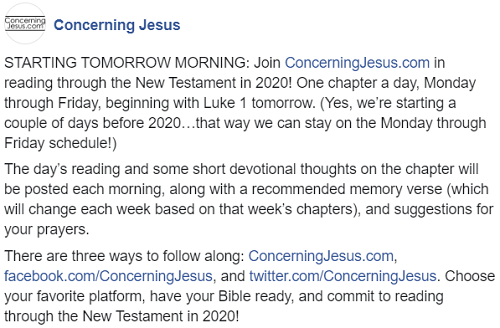
Read the New Testament in a year, one chapter a day, five days a week

Day 2/260: Read Luke 2

We have very little information about Jesus’ life before His public ministry. Luke relates one incident that occurred when Jesus was just twelve years old.

Joseph and Mary were faithful in their attendance of the Passover Feast in Jerusalem, traveling there each year. They journeyed with a large group of family and friends, and when they began their trip home after the feast, they did not realize that the pre-teen Jesus had been left behind in the city.

It isn’t difficult to imagine Joseph and Mary’s fear. They had been entrusted with the Son of God, and they lost Him! It took them three days to find Him; He was in the temple, “in the midst of the teachers.” At just twelve years of age, Jesus’ priorities were in order. He asked Mary, “Did you not know that I must be about My Father’s business?”

Do we ever lose sight of our Father’s business? We develop a routine of going to school or work, but do we lose sight of what is truly important? Where are our priorities? Do we go about our daily activities without any thought to how those activities can be used to accomplish God’s will in our life and the lives of those around us?

Memory (Copy into a notebook 5-10 times)

Luke 5:31-32: Jesus answered and said to them, “Those who are well have no need of a physician, but those who are sick. I have not come to call the righteous, but sinners, to repentance.”

Pray

Pray for opportunities to be about the Father’s business. Pray that He may use you to accomplish His will. Pray for those around you that you can influence in a positive way.

Read the New Testament in a year, one chapter a day, five days a week

Day 1/260: Read Luke 1

For the first time in hundreds of years, God spoke to one of His children. The person who received the message was Zacharias, a priest. While many priests were denounced throughout the Scriptures for various sins, Zacharias is called “righteous” and “blameless.” This does not mean he was perfect or sinless, but that he sought to serve God in his life.

If you died tomorrow, how would your obituary read? Could the preacher at your funeral say, with all sincerity, that you were “righteous” and “blameless” in your life? What changes do you need to make in your life to make those adjectives fit your description?

It is never too late to make a commitment to serve the Lord. We read of many servants throughout both the Old and New Testaments who overcame their weaknesses and by the grace of God were used for His purpose.

Paul reminded the saints in Corinth of what they “were” before coming to know Christ: unrighteous sinners who could not inherit the kingdom of God. Because of Christ, though, they changed their lives and “are washed…sanctified…justified.” (1 Cor. 6:9-11)

Memory (Read aloud 5-10 times)

Luke 5:31-32: Jesus answered and said to them, “Those who are well have no need of a physician, but those who are sick. I have not come to call the righteous, but sinners, to repentance.”

Pray

Pray for the wisdom to recognize your weaknesses and seek guidance in the Scriptures on how to become righteous and blameless in God’s sight.

Songs of Praise and Triumph (Isaiah 25:1-12)

Isaiah A Study of Selected Texts

Songs of Praise and Triumph (Isaiah 25:1-12)

  • 25:1-5 – “Praise of God for the great things He has done”
    • Yahweh/Jehovah – God’s faithfulness
    • Elohim/Lord – Lordship/Almightiness
    • Divine destruction causes glorification and fear
    • Christ’s church offers strength and protection (Matthew 11:28-32)
  • 25:6-8 – “The Marriage Supper of the Lamb and the prophecy of the end of death”
    • Symbolism of the “feast” (Luke 14:1ff; Matthew 22:1-14; 25:1-13)
    • Removing the veil (Ephesians 4:18; 2 Corinthians 3:14-16)
    • Assurance that death would cease
    • Wipe away tears (Revelation 7:17; 21:4)
  • 25:9-12 – “The ultimate triumph of God over all His enemies”
    • Discouragement overcome by faithful focus
    • Character of Moab (Genesis 19:30-38; Numbers 22:3-6; 25:1-2; Isaiah 16:6; Jeremiah 48:29-30; 48:27,42; Amos 2:1; Zephaniah 2:8,10)
    • Motivation in promises and warnings
    • “The faithful Covenant-God has protected and sustained and fed His kingdom upon the earth and it is alive and flourishing today. In contrast, those enemies who have threatened and warred against God’s kingdom have come and gone and dissolved into dust, one after another. So shall it ever be.” (Butler)

Discussion Questions

1. How important is singing to the people of God? What are some of the Scriptural purposes for singing? Consider James 5:13 as well as Colossians 3:16 in your answer.

2. What are the different meanings of the Hebrew names of God used in verse 1?

3. What is the literal mountain of verses 6 and 10? What does it symbolically represent?

4. What is the “feast of choice pieces”?

5. Is fear (terror) a proper motivation for serving God?

The Prophecy of the Coming Messiah (Isaiah 7:14-16; 9:1-7; 11:1-10)

Isaiah A Study of Selected Texts

The Prophecy of the Coming Messiah (Isaiah 7:14-16; 9:1-7; 11:1-10)

  • 7:14-16 – Prophecy of the virgin birth
    • Opposition from Rezin (Syria) and Pekah (Israel)
    • Fulfillment in Christ (Matthew 1:22-23)
  • 9:1-3 – Light in darkness
    • Prophecy of doom (Isaiah 8) vs. promise of joy (Isaiah 9)
    • Fulfillment in Christ (Matthew 4:12-17)
    • Jesus was the light (John 8:12; 1:9; 1:4; Malachi 4:2)
  • 9:4-7 – The basis of joy
    • Wonderful, Counselor (Col. 2:3; Isaiah 28:29), Mighty God (John 1:1; Isaiah 10:21), Everlasting Father (John 8:58; Colossians 1:17; Hebrews 12:2), Prince of Peace (Romans 5:1; Hebrews 12:14; Philippians 4:7)
    • Reign of the Messiah will be forever (Zechariah 9:10)
  • 11:1-5 – The character of Christ
    • Fulfillment in Christ (Romans 15:12)
    • Wisdom and understanding (intellectual faculties)
    • Counsel and might (practical qualities)
    • Knowledge and fear of Jehovah (moral life)
  • 11:6-9 – The character of His subjects
    • Representative of how citizens of Christ’s kingdom should relate to each other
  • 11:10 – The extent of His kingdom
    • Gentiles included in the promise
    • No more separation of Jew and Gentile (Ephesians 2:11-22; Zechariah 9:9-10; Galatians 3:28)

Discussion Questions

1. Do you believe Isaiah 7:14 to be a “dual fulfillment” prophecy? Why or why not?

2. Which of the descriptive names of Isaiah 9:6 is your favorite?

3. Who was Jesse?

4. What is represented in Isaiah 11:6-8?

5. Who is eligible to be a part of Christ’s kingdom?

“Here Am I! Send Me!” (Isaiah 6:1-13)

Isaiah A Study of Selected Texts

“Here Am I! Send Me!” (Isaiah 6:1-13)

  • 6:1-4 – Isaiah’s vision
    • King Uzziah’s death (2 Chronicles 26:4, 16-21); probably around 740 B.C.
    • The seraphim: six-winged beings; different than cherubim (Ezekiel 11:22)
    • “Holy, holy, holy!”
    • The house filled with smoke (cf. Revelation 15:7-8)
  • 6:5 – Isaiah recognizes his unworthiness
    • “All have sinned” (Romans 3:23)
    • Normal reaction – Gideon (Judges 6:22); Manoah (Judges 13:22); Job (Job 42:5,6); Peter (Luke 5:8); John (Revelation 1:17); the thief (Luke 23:40,41)
    • This vision is of the preincarnate Christ (John 12:36-41)
  • 6:6-7 – God’s forgiveness
    • “He who a moment before felt that in the presence of the Holy God sin could not exist, and that therefore he must perish with his sin, now felt that he was separated from his sin so that it alone might perish, and he might live.” (Rowley)
    • We must seek purification (Psalm 51:10-13)
    • Example of Saul of Tarsus (Acts 8:3; 9:1; 26:9-11; 22:16)
  • 6:8-13 – Isaiah’s commission
    • “Who will go for Us?” (cf. Genesis 1:26; John 1:1)
    • “Here am I! Send me!”
    • God warns of the hardening of hearts
    • “Yet a tenth”; “So the holy seed shall be its stump”

Discussion Questions

1. Why is it important to recognize the holiness of God in contrast to our sinfulness?

2. What effect did the vision have on Isaiah?

3. What duty did Isaiah have? What is our duty today?

4. Why did God use the word “Us” in verse 8?

5. Reconcile verse 10 with passages such as 2 Peter 3:9.

Isaiah’s Parable of the Vineyard (Isaiah 5:1-12)

Isaiah A Study of Selected Texts

Isaiah’s Parable of the Vineyard (Isaiah 5:1-12)

  • 5:1-2 – The vineyard as a symbol of Israel (Psalm 80; Jeremiah 12:10; Mark 12:1-10)
    • Isaiah adapts his delivery but not the message
    • “My Well-beloved” = God
    • “The choicest vine” = Abraham, Isaac, Jacob
    • “Wild grapes” are toxic/poisonous
  • 5:3-6 – A song of lament
    • Similar in method to Nathan (2 Samuel 12:1-15) and Jesus (Matthew 21:33-43; Mark 12:1-9)
    • Limits of God’s power: He will not violate man’s free will (Matthew 23:37; 2 Peter 3:9)
  • 5:7 – The meaning of the parable
    • Paronomasia (pun in which the words sound similar but have different meanings)
    • Justice (mishpat) vs. oppression/bloodshed (mispah)
    • Righteousness (sedakah) vs. a cry (seakah)
  • 5:8-10 – The first woe
    • Against land-grabbing (Micah 2:2; Jeremiah 22:13-17; Habakkuk 2:9-12)
    • Drastically reduced harvest (Leviticus 26:20; Deuteronomy 26:15,18; Haggai 1:5-6)
  • 5:11-12 – The second woe
    • Against drunken revelry (1 Peter 4:1-4; Ephesians 5:18; Romans 13:13; Galatians 5:19-21)
    • God was not a priority (Amos 6:1-7; Matthew 6:33; Colossians 3:1-2)

Discussion Questions

1. What had God done to ensure the success of the vineyard?

2. How did God respond to the vineyard’s failure?

3. What is wrong with acquiring houses and fields?

4. What are some popular songs that Christians should avoid because of content?

5. Jesus warned against a preoccupation with the “riches and pleasures of life” (Luke 8:14); what is the result of such according to Christ?

Rebellion and Restoration (Isaiah 1:1-20)

Isaiah A Study of Selected Texts

Rebellion and Restoration (Isaiah 1:1-20)

  • 1:1 – Isaiah = Yesha-Yahu = “Jehovah is salvation”
    • Son of Amoz; married to a prophetess (8:3); 2 sons (7:3; 8:3)
    • Prophesied during the reigns of Uzziah (767-740 BC), Jotham (750-736 BC), Ahaz (736-716 BC), Hezekiah (716-698 BC)
  • 1:2-9 – Judah is a “sinful nation,” “laden with iniquity,” “brood of evildoers,” “corrupters”
    • Their sin caused suffering
    • Is suffering always caused by sin? (Job 1:1; 1 Peter 3:17)
    • The description of desolation consistent with Micah 6:13-16 and corresponds with Lev. 26 and Deut. 28
  • 1:10-15 – God does not want sacrifice without submission
    • Proverbs 15:8; 1 Timothy 2:8; James 5:16
    • “Rite without right is wrong” (Clyde M. Woods)
  • 1:16-17 – Restoration is called for
    • “Repentance is surrender; a change of thinking, willing, acting; a life directed toward the will of God as revealed in His Word” (Butler)
    • Cessation of evil must be accompanied by commencement of right (Ephesians 4:25-32)
  • 1:18-20 – Reason is a big part of righteousness
    • Paul reasoned (Acts 17:2,17; 18:4,19; 19:8-9; 24:25)
    • “The words of truth and reason” (Acts 26:25)
    • Living sacrifice = “reasonable service” (Rom. 12:1)
    • Choice: “willing and obedient” or “refuse and rebel” (Romans 11:22)

Discussion Questions

1. What is the force of the comparison of the people of Judah to the ox and donkey?

2. What sickness did the people have?

3. God commanded sacrifices through Moses; here, He says He takes no pleasure in them. Does He contradict Himself?

4. What positive commands were the people given?

5. Is it reasonable to serve God? Why or why not?

Keep Going!

Evangelism

          Your friend said he wasn’t interested in hearing about religion. He doesn’t need Jesus; he’s happy in his denomination; he thinks, “We’re all going to heaven, just taking different paths.” We don’t like rejection, but rejection is a part of evangelism. Does that mean we should give up?
          “And let us not grow weary while doing good, for in due season we shall reap if we do not lose heart” (Galatians 6:9). As we discussed in our examination of the parable of the sower, our job is to scatter that seed. We cannot force someone to accept the truth, nor can we force them to even listen to it. However, we must take seriously our role as sowers, realizing there are many who will ignore the gospel but praying for those who will obey.
          Jesus prayed for the people who would believe. He prayed for His apostles, then said, “I do not pray for these alone, but also for those who will believe in Me through their word; that they all may be one, as You, Father, are in Me, and I in You; that they also may be one in Us, that the world may believe that You sent Me” (John 17:20-21). If Jesus prayed for prospective converts, shouldn’t we do the same?
          We need to be watchful for opportunities to share God’s love, even with those who have resisted it in the past. One who may not initially be aware of his need for the Lord can change his mind over time. A major event in life may disrupt a friend’s status quo, and that could be a perfect opportunity to get him to think seriously about Jesus. His invitation is always open: “Come to Me, all you who labor and are heavy laden, and I will give you rest. Take My yoke upon you and learn from Me, for I am gentle and lowly in heart, and you will find rest for your souls. For My yoke is easy and My burden is light” (Matthew 11:28-30).
          Our attitude is extremely important in evangelism. Some people are very fluent in sarcasm, but we need to recognize there are situations that call for seriousness. If we never show that we can be serious, our friends will never confide in us when they are struggling. They don’t want to be mocked, but comforted.
          “Let no corrupt word proceed out of your mouth, but what is good for necessary edification, that it may impart grace to the hearers….Let all bitterness, wrath, anger, clamor, and evil speaking be put away from you, with all malice. And be kind to one another, tenderhearted, forgiving one another, just as God in Christ forgave you” (Ephesians 4:29,31-32). This applies to social media (written word) as much as the spoken word. When hateful, spite-filled memes dominate your profile, serious conversations will be difficult to come by. Kindness trumps bitterness.
          “Brethren, if a man is overtaken in any trespass, you who are spiritual restore such a one in a spirit of gentleness, considering yourself lest you also be tempted. Bear one another’s burdens, and so fulfill the law of Christ” (Galatians 6:1-2). Brother Kerry Williams asks a very thought-provoking question: “If we should approach a weak brother in such a way, how much more should we approach unbelievers with gentleness?” (Kerry W. Williams, Fishers of Teens, p. 37).
          Consider how Aquila and Priscilla dealt with Apollos, and how he responded. “Now a certain Jew named Apollos, born at Alexandria, an eloquent man and mighty in the Scriptures, came to Ephesus. This man had been instructed in the way of the Lord; and being fervent in spirit, he spoke and taught accurately the things of the Lord, though he knew only the baptism of John. So he began to speak boldly in the synagogue. When Aquila and Priscilla heard him, they took him aside and explained to him the way of God more accurately. And when he desired to cross to Achaia, the brethren wrote, exhorting the disciples to receive him; and when he arrived, he greatly helped those who had believed through grace; for he vigorously refuted the Jews publicly, showing from the Scriptures that Jesus is the Christ” (Acts 18:24-28).
          Did Aquila and Priscilla stand up and interrupt Apollos? Did they shout him down? No! The Scriptures say that “they took him aside and explained to him the way of God more accurately.” There is an implication of gentleness. They didn’t want to embarrass him or diminish his zeal one bit. They simply wanted him to have the full story so he could lead others to the truth.
          You likely have friends that are passionate about their religion. They may be involved in their church and active in service. Perhaps you can find an opportunity to take them aside and study the truth more deeply. Invite them over for dinner with your family. Highlight the areas wherein you agree…don’t diminish the fact that they do believe that Jesus is the Son of God! Encourage them to keep developing that faith through a study of the Word, and explore what His Word says about obedience, specifically the gospel plan of salvation. “Explain the way of God more accurately”…“in a spirit of gentleness.”
          Why is it important for us to do this? Paul writes, “And to give you who are troubled rest with us when the Lord Jesus is revealed from heaven with His mighty angels, in flaming fire taking vengeance on those who do not know God, and on those who do not obey the gospel of our Lord Jesus Christ. These shall be punished with everlasting destruction from the presence of the Lord and from the glory of His power” (2 Thessalonians 1:7-9).
          “Do you have a lost friend? Do you intend to try and talk to that person about Jesus? If not, then maybe you should ask yourself one final question. What kind of friend am I?” (Kerry W. Williams, Fishers of Teens, p. 39).

Discussion and Action

1. What is going to happen to those who do not know and do not obey the gospel? Who is going to teach your friends if you don’t?

2. Can you think of opportunities that you have neglected? Learn from those missed opportunities and grab ahold of them next time!

3. Keep working on memorizing the gospel plan of salvation and the verses that go along with each step.

4. This class is over, but don’t forget about the five names you wrote down. Will you be a true friend and teach them about the Lord?

But when they believed Philip as he preached the things concerning the kingdom of God and the name of Jesus Christ, both men and women were baptized. (Acts 8:12)