All posts by JT

Christian. Husband. Dad. Preacher. Baseball fan. Music nerd. Bookworm.

The Home and Evangelism

The Home and Evangelism

I. The Great Commission

    A. “all nations” (Matthew 28:19-20)
    B. “all the world…every creature” (Mark 16:15)
    C. Where did they start? “in Jerusalem…Judea…Samaria…the end of the earth” (Acts 1:8)
    D. We start where we are with those we care about most – our immediate sphere of influence – our home

II. Teaching our children

    A. Commanded in the Old Testament (Deuteronomy 6:6-9; Proverbs 22:6)
    B. Commanded in the New Testament (Ephesians 6:4)
    C. Elders’ children are to be “faithful…not accused of dissipation or insubordination” (Titus 1:6)

III. The influence of godly parents and spouses

    A. As an example to children/grandchildren – Timothy’s grandmother Lois and mother Eunice (2 Timothy 1:5; 3:14-15)
    B. As an example to unbelieving spouses (1 Peter 3:1-2; 1 Corinthians 7:12-16)

IV. Examples of family evangelism

    A. Andrew brought Peter to Jesus (John 1:40-42)
    B. Inviting evangelists into one’s home

      1. Cornelius (Acts 11:13-14)
      2. Lydia (Acts 16:14-15)
      3. The Philippian jailer (Acts 16:30-34)
      4. Crispus (Acts 18:7-8)

V. How do we evangelize in our family today?

    A. Pray for them and for yourself for opportunities (Ephesians 6:18-19)
    B. Study to be prepared to answer their questions (2 Timothy 2:15; 1 Peter 3:15)
    C. Look for opportunities to teach
    D. Invite them to hear other teachers (Friends & Family, Gospel Meetings, VBS, weekly worship services and classes)
    E. Set up a home Bible study – if you are not comfortable leading this yourself, there are several others in the congregation that are willing and able to teach privately

Useful

When Barnabas and Saul embarked on their first missionary journey, John Mark traveled with them as their assistant (Acts 13:5), but he did not stay with the mission long (Acts 13:13). We are not told the precise reason for Mark’s departure, but he violated Paul’s trust when he left.

In fact, Paul’s distrust was so great that he refused to give Mark another chance on his second missionary trip, despite Barnabas’ suggestion. “Then the contention became so sharp that they parted from one another” (Acts 15:39).

Paul was focused on the work and strengthening the churches that were established during the first trip, and did not want to be distracted by Mark’s shortcomings; Paul did not want to risk a second abandonment. Barnabas, on the other hand, wanted to encourage Mark in his labors for the Lord and provide him the emotional support he needed in his service.

How many people disappear from the Lord’s service today? What should we do when we see someone drifting away from the faith? Paul himself wrote that we should “restore such a one in a spirit of gentleness, considering yourself lest you also be tempted” (Galatians 6:1).

When we mess up, we may disappoint family and friends, but that does not mean we are forever useless. It may take time to rebuild trust, but if we are diligent and faithful, it can be accomplished, just as Mark eventually won back Paul’s trust (2 Timothy 4:11).

It starts small. We should not expect someone to entrust us with a major task if we have not proved ourselves with simpler things. Read Jesus’ parable of the talents in Matthew 25:14-30. What does Jesus say to those who were faithful and fruitful? What does He say to the man who did nothing with that which was entrusted to him?

It is very important that we serve the Lord to the best of our ability and not give up. But if we do stumble, know that we can turn ourselves around and become useful to Him again.

Walking in God’s Light

walking in Gods light 1973 Topps

1 John 1:5-2:2

I. “GOD IS LIGHT AND IN HIM IS NO DARKNESS AT ALL” (1 John 1:5)

    A. God is light

      1. The Father of lights (James 1:17)
      2. The Creator of light (Genesis 1:3)
      3. Dwells in unapproachable light (1 Timothy 6:16)
      4. Calls us into His marvelous light (1 Peter 2:9)

    B. Darkness is the realm of Satan (Ephesians 6:11-12; Colossians 1:3; Ephesians 5:8)

II. SIX “IF” STATEMENTS

    A. “If we say that we have fellowship with Him, and walk in darkness, we lie and do not practice the truth.” (1 John 1:6; Matthew 6:2,5,16; Galatians 2:11-13)
    B. “But if we walk in the light as He is in the light, we have fellowship with one another, and the blood of Jesus Christ His Son cleanses us from all sin.” (1 Jn 1:7)
    C. “If we say that we have no sin, we deceive ourselves, and the truth is not in us.” (1 John 1:8; Galatians 6:3; James 1:22)
    D. “If we confess our sins, He is faithful and just to forgive us our sins and to cleanse us from all unrighteousness.” (1 John 1:9)
    E. “If we say that we have not sinned, we make Him a liar, and His word is not in us.” (1 John 1:10; Romans 3:23)
    F. “And if anyone sins, we have an Advocate with the Father, Jesus Christ the righteous.” (1 John 2:1a)

III. WHAT WE HAVE AS A RESULT OF WALKING IN GOD’S LIGHT

    A. Fellowship (1 John 1:7)
    B. Cleansing (1 John 1:7,9; Romans 5:9; Ephesians 1:7; 1 Peter 1:18-19; Ephesians 2:13; Colossians 1:20)
    C. Forgiveness (1 John 1:9)
    D. An Advocate who serves as the propitiation (1 John 2:1-2; 4:9-10)

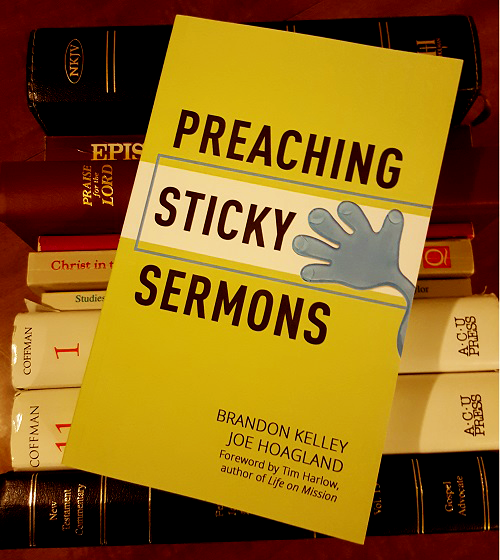
Book Review: Preaching Sticky Sermons by Brandon Kelley and Joe Hoagland

Preaching Sticky Sermons

Preaching Sticky Sermons
by Brandon Kelley and Joe Hoagland
Rainer Publishing, 2017

Whether you have been preaching for decades or just a few months, every man who stands in the pulpit can learn more about the art of preparing and delivering a sermon. Preaching Sticky Sermons is divided into four sections, focusing on preparation, writing, delivery, and evaluation. Many of the tips found in the book are reminders of long-held truths, while others are suggestions on using more modern technological tools to better engage the congregation. The bottom line throughout, however, is not only preaching more effectively, but preaching so that the hearts of the congregation are turned toward the Word.

The authors encourage the use of Evernote, a free app available for smart phones; they also offer a free download of resources to use with Evernote. I have attempted to use the app on several occasions, but I personally do not find it efficient. Others use it and use it well; it boils down to what you are comfortable with. I prefer old-fashioned note-taking, and feel that Evernote is more of a burden than a blessing to me.

Though the authors come from a different religious background, doctrine is not directly discussed in this volume. The focus of Preaching Sticky Sermons is not Biblical content, but how to deliver Biblical content. A commitment to the revealed Word is encouraged. They write, “Every sermon you preach should be focused on God’s Word, not your own ideas, opinions, or anecdotes. If you want to see God work in a special ay through your message, it must be biblically true.” Elsewhere, they write, “If you stick to preaching the truth of Scriptures, people will be offended, but they won’t be offended because of some idea you came up with. They’ll be offended because the Word of God is sharper than any double-edged sword. It pierces to the depths of the heart. Let it do its job.” If every denominational preacher would do just that, we could do away with the sinful divisiveness in the religious world today.

Kelley and Hoagland’s book can be a great benefit to preachers, helping them to strengthen their delivery on Sunday by looking more closely at their preparation and evaluation. There are even tips on how to take the sermon past Sunday and give it more life through further writing. Preaching Sticky Sermons is an encouraging book for preachers, young and old.

Purchase Preaching Sticky Sermons by Brandon Kelley and Joe Hoagland.

[Disclosure: Rainer Publishing provided a complimentary copy of this book to Handling Aright in exchange for a review. The opinions expressed belong to the reviewer, and a positive review was not required by the publisher.]

Why Did John Write?

whydidjohnwrite

1 John 1:1-4

I. “THAT YOUR/OUR JOY MAY BE FULL” (1 John 1:4)

    A. Divine fellowship (1 John 1:3; 1:7; 3:24)
    B. God’s forgiveness (1 John 1:9)
    C. Brotherly love (1 John 4:7-11)
    D. Your teachers rejoice in your faithfulness

II. “THAT YOU MAY NOT SIN” (1 John 2:1)

    A. “Because your sins are forgiven for His name’s sake” (1 John 2:12; Romans 5:20-6:2; Psalm 103:12)
    B. “Because you have known Him who is from the beginning” (1 John 2:13,14; John 17:3)
    C. “Because you have overcome the wicked one” (1 John 2:13,14; 4:4; 5:4-5)
    D. “Because you have known the Father” (1 John 2:13; Jeremiah 31:33-34)
    E. “Because you are strong and the word of God abides in you” (1 John 2:14; 2 John 1:9)

III. “THAT YOU MAY KNOW THAT YOU HAVE ETERNAL LIFE, AND THAT YOU MAY CONTINUE TO BELIEVE IN THE NAME OF THE SON OF GOD” (1 John 5:13)

    A. How does one acquire faith? (Romans 10:17)
    B. Eternal life is a promise from the Father to the faithful (1 John 2:25; Titus 1:2; John 17:1-3)
    C. The Spirit inspired the Word to produce faith in us (John 17:20; 20:30-31)

Our Relationship to the World

Paul wrote that Christians were “not to keep company with sexually immoral people. Yet I certainly did not mean with the sexually immoral people of this world, or with the covetous, or extortioners, or idolaters, since then you would need to go out of the world” (1 Corinthians 5:9-10). He reminded the Ephesians that before their conversion, “you were without Christ, being aliens from the commonwealth of Israel and strangers from the covenants of promise, having no hope and without God in the world. But now in Christ Jesus you who once were far off have been brought near by the blood of Christ” (Ephesians 2:12-13).

How did those Christians become Christians? “How then shall they call on Him in whom they have not believed? And how shall they believe in Him of whom they have not heard? And how shall they hear without a preacher?…So then faith comes by hearing, and hearing by the word of God” (Romans 10:14,17). It has been said that every Christian is a walking sermon, so we should carefully consider our conduct when we are in the company of those who are outside the church. Our example and influence could be what leads them to Christ, but it could also be what drives them away.

With these things in mind, let us consider the Lord’s teaching as it refers to His disciples’ relationship to the world: “You are the salt of the earth; but if the salt loses its flavor, how shall it be seasoned? It is then good for nothing but to be thrown out and trampled underfoot by men. You are the light of the world. A city that is set on a hill cannot be hidden. Nor do they light a lamp and put it under a basket, but on a lampstand, and it gives light to all who are in the house. Let your light so shine before men, that they may see your good works and glorify your Father in heaven.”

How have you let your light shine so far in 2017?

Be better, live better, serve better

A new year is upon us; many people make resolutions to better themselves. Eat healthier, exercise more, read more, write more, learn a new instrument…the potential positive resolutions are numerous. There are, of course, more important resolutions than these. Children of God should be continually examining themselves spiritually and resolving to be better, not just at the beginning of the calendar year.

The apostle Paul wrote in Philippians 3:12-14, “Not that I have already attained, or am already perfected; but I press on, that I may lay hold of that for which Christ Jesus has also laid hold of me. Brethren, I do not count myself to have apprehended; but one thing I do, forgetting those things which are behind and reaching forward to those things which are ahead, I press toward the goal for the prize of the upward call of God in Christ Jesus.”

Paul recognized that he still had work to do. He knew he could be better, live better, serve better. Christians today should realize that we, too, must continue to “press toward the goal” as long as we have breath in us. We cannot allow our past mistakes and forgiven sins to hold us back, rather “forgetting those things that are behind” (the failures of 2016) “and reaching forward to those things which are ahead” (the opportunities that await us in 2017 and beyond).

Can you resolve each morning that you wake up to be better than you were yesterday? Live better than you did yesterday? Serve better than you did yesterday?

An update from the Gatlinburg congregation

House of Pancakes
Turn here to reach the current meeting place of the Gatlinburg church of Christ at 189 West Ogle St, Gatlinburg TN

Rod Rutherford reports that the saints in Gatlinburg are currently meeting at 189 West Ogle Drive, off Highway 321; turn at the “Little House of Pancakes.” The church is leasing this meeting space until their building can be rebuilt. They are still in need of financial assistance to help members and others in the area.

Learning from Aquila and Priscilla

Acts 18:1-4

I. Honorable

    A. In life (Acts 18:2; 1 Peter 4:1-4)
    B. In work (Acts 18:3; 1 Timothy 5:8; 2 Thessalonians 3:10-12; Proverbs 31)

II. Hospitable

    A. Opened their home to Paul (Acts 18:3)
    B. Opened their home to the church (Romans 16:5; 1 Corinthians 16:19)
    C. A commandment of God (Romans 12:13; 1 Timothy 3:2; Titus 1:8; 1 Timothy 5:10; 1 Peter 4:9)

III. Humble

    A. In teaching (Acts 18:24-26)
    B. “Risked their own necks” (Romans 16:3-4; Philippians 2:5-8)

Alive in Christ

I answer some interesting phone calls at the 911 center. Just a few days ago, I spoke to a confused individual who was trying to figure out whether he was alive or dead. After determining his location, my co-workers sent police and an ambulance to help him. The officers wanted him to come downstairs to his front door to meet them, to which he said, “Well, if I’m a ghost, I can just float down there!” I agreed with his logic, and suggested that he try walking through the door without opening it. “If you can’t float through the door, you’re not a ghost,” I advised.

While the incident was amusing and sad at the same time, many Christians live in the same state of doubt, unsure whether they are alive or dead spiritually. When a person obeys the gospel, God moves him from a state of spiritual death to life.

“And you He made alive, who were dead in trespasses and sins, in which you once walked according to the course of this world, according to the prince of the power of the air, the spirit who now works in the sons of disobedience, among whom also we all once conducted ourselves in the lusts of our flesh, fulfilling the desires of the flesh and of the mind, and were by nature children of wrath, just as the others. But God, who is rich in mercy, because of His great love with which He loved us, even when we were dead in trespasses, made us alive together in Christ (by grace you have been saved), and raised us up together, and made us sit together in the heavenly places in Christ Jesus, that in the ages to come He might show the exceeding riches of His grace in His kindness toward us in Christ Jesus.” (Ephesians 2:1-7).

Don’t be confused anymore. If you have obeyed from the heart the gospel and are striving to live faithfully for the Lord, you are alive in Him!