All posts by JT

Christian. Husband. Dad. Preacher. Baseball fan. Music nerd. Bookworm.

A Study of Revelation: Revelation 8-11 (The Seventh Seal & the Seven Trumpets)

Revelation 8-11 (The Seventh Seal & the Seven Trumpets)

8:1-6 – Seven (completeness) trumpets – a great announcement that will be heard everywhere
Signaling the end of the Jewish world (Matthew 24:3,14)

8:7 – The earth represents the home of the Jewish persecuting powers

8:8-9 – Mountains symbolize government
The sea represents the Roman powers

8:10-11 – The great star falling from heaven represents the downfall of Jerusalem’s ruling elite

8:12-13 – Three woes directed toward the “earth” – Jewish powers

9:1-12 – The siege
The star falling from heaven is here the power of Satan (cf. Luke 10:18; Isaiah 14:12)
The locusts are noteworthy for their destruction
Scorpions bring great agony to victims
The “angel of the bottomless pit” = Satan personified in the persecutor
Abaddon = Apollyon = “destroyer”

9:13-21 – The fall of Jerusalem by sword
Angels were restrained in Rev. 7; their release shows that God’s faithful recognized these events as those about which the Lord prophesied (Matt. 24) and took flight
Idolatry (Ephesians 5:5; Colossians 3:5)
The four sins of v.21 were the same as charged against Jezebel (1 Kings 2:14-15; 2 Kings 9:22)

10:1-4 – “Unknown things are greater in seeming proportion than the things that are known”
Position of angel’s feet showed power of persecuting powers of Jerusalem (land) and Rome (sea)
God has revealed all we need to know (2 Peter 1:3)

10:5-7 – Examples of God swearing by Himself (Gen. 22:16; Isa. 45:23; Psalm 89:35; Heb. 6:13)

10:8-11 – God’s promises are sweet, but the pronouncements against the disobedient are bitter (Romans 11:22)

11:1-6 – 42 months/1260 days = 3 ½ years, the exact length of the historical siege of Jerusalem – one of the very few instances of a literal number in Revelation
The power = the miraculous manifestation of the Spirit in 1st century preachers (Matthew 10:18-20)
Testimony of two based on Moses (Deut. 19:15; Heb. 10:28) and Christ (Luke 10)

11:7-10 – The beast = persecuting emperor = “angel of bottomless pit” (9:11)
Sodom and Egypt are used to illustrate Jerusalem

11:11-14 – Resurrection of witnesses shows the power of God’s truth; HIS TRUTH CANNOT BE DEFEATED
Earthquakes = uprisings and upheavals in human affairs

11:15-19 – The appearance of the ark “symbolized that what was lost in the old is restored in the new”

Review
1. The seven trumpets signaled the beginning of the end of what?

2. What is represented by the star falling from heaven in chapter 9?

3. Why is the little book sweet to taste but bitter in the stomach?

4. What is the power in Revelation 11:3?

A Study of Revelation: Revelation 6-7 (The First Six of the Seven Seals)

Revelation chapters 6-7 (The First Six of the Seven Seals)

6:1-2 – The first seal, the white horse
Thunder is the sign of an approaching storm; also symbolizes the demonstration of God’s power poured out in wrath upon His enemies
Horses were noble creatures and warriors
White represents either purity or victory – probably victory here
The bow indicated a long battle

6:3-4 – The second seal, the red horse
Red represents the bloodshed to come against the persecutors of God’s children

6:5-6 – The third seal, the black horse
Black is a symbol of distress; famine was coming
Scales were used to measure food so none was wasted
Oil and wine could be used medicinally

6:7-8 – The fourth seal, the pale horse
Pale represents death by sword (war), hunger (famine), death (pestilence or disease), and wild beasts (devoured)
Not separate events; all pointed to the fall of Jerusalem

6:9-11- The fifth seal reveals the martyrs

6:12-17 – The sixth seal, the fall of Judean power
Earthquakes = unrest between nations
Sun = great political leader
Moon = great religious leader
Stars = lesser officials
Mountains = people who worship God
Islands = pagan Gentile nations
Sky = existing government over all
Similar imagery used by Isaiah (29:6; 13:10) and Jesus (Matthew 24:7,29)
6:16 – similar to language of Hosea 10:8, which Jesus quoted in reference to destruction of Jerusalem (Luke 23:30)
6:17 – alludes to Nahum 1:5-6

7:1-3 – Interlude between 6th and 7th seals
While the children of God would be spared from the judgment upon Jerusalem, this did not prevent tribulation in their lives (cf. 2 Timothy 3:12)

7:4-8 – 144,000
Not intended to be a literal number
The use of 12 and 1000 indicated fullness and completeness
Designated the whole church, spiritual Israel

7:9-17 – Another vision of praise
The white of the robes could refer to the purity or the victory received

Review
1. Who opened each of the first six seals?

2. What did each color of the horsemen represent?

3. When would God execute His judgment against His people’s oppressors?

4. What do the symbols of 6:12-13 represent?

5. How many people in the tribes of Israel are sealed? Is this a literal number?

6. What are the two possible meanings of the white robes at the end of chapter 7?

A Study of Revelation: Revelation 4-5 (The Throne Scene)

Revelation chapters 4-5 (The Throne Scene)

4:1-3
The One on the throne was (and still is) God
Jasper and sardius stone – righteousness and mercy
Rainbow – brings to mind God’s covenant after the flood (Genesis 9:12-17)

4:4-5
24 elders represent 12 tribes and 12 apostles
“Lightnings, thunderings, and voices” – Jehovah’s omnipotent nature (cf. Exodus 19:16)

4:6-8
Sea represents society
Lion = ferocious strength
Calf (ox) = great endurance under burden
Man = intelligence, reason, and wisdom
Eagle = penetrating vision and swiftly executed judgment
Living creatures similar to seraphim (Isaiah 6:1-3)

4:9-11
Casting crowns shows humility, knowledge that power comes from God

5:1-5
Seals restricted unauthorized people from opening it to reveal its contents
“The Lion of the tribe of Judah, the Root of David” – refers to blessing Jacob gave to Judah (Genesis 49:8-10) and the royal relation to David
The paradox of “the Root of David” – Christ sprang from David, but was the Lord of David (Isaiah 11:1,10; Romans 15:12; Zechariah 3:8; 6:12)

5:6-7
The sacrificial Lamb without blemish (Isaiah 53:7; John 1:29,36; 1 Peter 1:18-21)
Seven horns – symbolize full and complete authority

5:8-10
The harps are symbolic of joy and praise
Remember…SYMBOLIC
This does not give us any more authority to use literal instruments in praise than it gives us the authority to use literal incense in prayers!

5:11-14
It is no accident that He is declared worthy to receive seven things, as seven is the symbolic number of completeness

Review
1. What was the covenant God made with man which is represented by the rainbow?

2. What do the twenty-four elders represent?

3. What are the four living creatures, and what do they symbolize?

4. Who was worthy to open the scroll and loose its seals? In what three ways is He depicted?

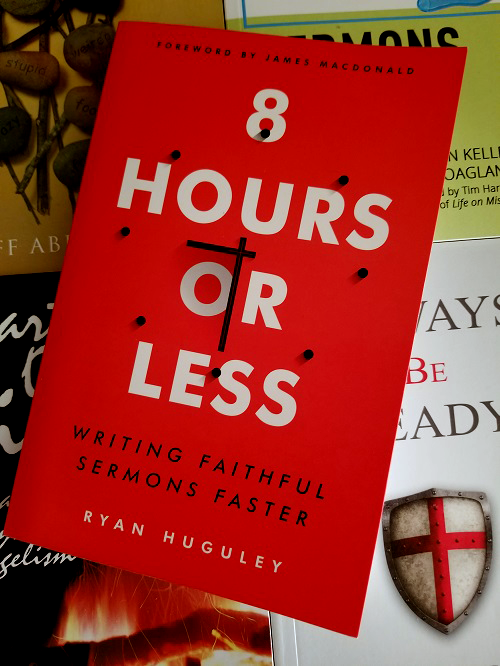
Book review: 8 Hours or Less: Writing Faithful Sermons Faster by Ryan Huguley

8 Hours or Less

8 Hours or Less: Writing Faithful Sermons Faster
by Ryan Huguley
Moody Publishers, 2017

Sermon prep books are plentiful—so plentiful, in fact, that it would be nearly impossible to read them all and still have time to prepare a sermon for the coming Sunday! Ryan Huguley’s offering into the subject matter, 8 Hours or Less: Writing Faithful Sermons Faster, lays out a plan to attacking sermon prep for a few hours each day, Monday through Friday, along with an additional hour Sunday morning before delivering the lesson. The concept is simple, but will not fit everyone’s personality. Some find it difficult to do a little here, and a little there, as Huguley suggests. Still, his recommendations can be stylized to a preacher’s individual habits, making for a more efficient use of study time.

Young preachers who have yet to find their footing may benefit more from Huguley’s 8 Hours or Less than veterans who have developed firmly established routines. I could have used this book fifteen years ago as I struggled from week to week wondering, “What will I preach on Sunday?” I would personally rearrange and combine some of Huguley’s daily tasks so that they are not stretched over the full week, but the idea of setting deadlines for each task would have helped a great deal.

After defining what a faithful sermon is, Huguley breaks his schedule down into six areas: “Build the Frame” on Monday, which involves prayer, deep textual study, consideration of commentaries, and the actual building of the frame; “Open the Door” on Tuesday, inviting trusted co-workers in Christ to give feedback on where you plan to go with the sermon; “Sweat the Intro” on Wednesday, crafting an introduction that will capture the congregation’s attention; “Land the Plane” on Thursday, focusing on the conclusion to the lesson; “Fill in the Frame” on Friday, fleshing out the outline with illustrations and applications that show the people the relevance of God’s Word in their lives; and “Finish Strong” on Sunday, which includes additional prayer and final edits to your notes or manuscript.

Huguley recognizes that this method, which works for him, may not work for everyone. “So eat the fish and spit out the bones,” he writes. “If you find that something I’ve recommended does not work for you, don’t use it.” There are some good suggestions, and some worthwhile encouragements, but it is not likely that everything in 8 Hours or Less will fit your style.

Purchase 8 Hours or Less: Writing Faithful Sermons Faster by Ryan Huguley.

[Disclosure: Moody Publishers provided a complimentary copy of this book to Handling Aright in exchange for a review. The opinions expressed belong to the reviewer, and a positive review was not required by the publisher.]

Try and Take Over the World

          Pinky and the Brain made their television debut in 1993 on Animaniacs. They were a pair of genetically enhanced lab mice, one of whom is bent on world domination. The running gag has the dim-witted Pinky ask, “What are we going to do tonight, Brain?” His counterpart answers, “The same thing we do every night, Pinky, try and take over the world!”
          Shouldn’t our goal be the same while we live on this earth? No, we are not looking to selfishly seize all the power, but should we not try to lead all of our friends and neighbors to the truth? Leading other to Christ, allowing Him to rule our decisions and theirs, so that we are all a part of the family of God…what more nobler goal could there me than to “try and take over the world” with Christ’s love and mercy?
          Christ told the eleven, “Go into all the world and preach the gospel to every creature” (Mark 16:15). Did they do that? Paul says the faith “was preached to every creature under heaven” just a few decades later (Colossians 1:23).
          We have so many tools for evangelism at our disposal today, from Facebook to YouTube to Twitter, but don’t forget good, old-fashioned, face-to-face, “Hey, what are you doing on Sunday? We’d love to have you worship with us, and we’ll go grab some lunch afterwards.”
          Do you know someone who might be interested in a Bible study? Even if you don’t feel prepared to lead such a study, you can set one up with another member of the church and learn by sitting with them as they teach. This is a Scriptural: “And the things that you have heard from me among many witnesses, commit these to faithful men who will be able to teach others also” (2 Timothy 2:2).
          As you go about your week, think of Pinky and the Brain. “What are we going to do today, Christian?”
          “The same thing we do every day, brother, try and take over the world…for Christ.”

We are the Children of God

1 John 3:1-15

I. WE ARE THE CHILDREN OF GOD

    A. Taylor: “A love we don’t deserve, yet in which we may delight” (1 John 3:1; John 3:16; Romans 5:8)
    B. The world does not approve of the Christian life, nor do they acknowledge God as the Almighty (1 John 3:1; John 15:18-19)
    C. The promise of being like Him (1 John 3:2; 1 Corinthians 15:42-44, 51-53, 57; Philippians 3:20-21)
    D. Hope – a blessed assurance, an eager perseverance (1 John 3:3; Romans 8:24-25; 1 Peter 2:21-22)

II. THE CHILD OF GOD AND SIN

    A. The sin in view here is continual and habitual – not occasional weaknesses
    B. Christ came to take away our sins (1 John 3:4-6)
    C. The righteousness here is continual and habitual (1 John 3:7-8)
    D. Love for sin is 100% incompatible with devotion to Deity

III. THE SIGNS OF RIGHTEOUSNESS

    A. We are a family – we must love one another (1 John 3:10-11)
    B. The unrighteous example of Cain (1 John 3:12; Genesis 4:1-8; Hebrews 11:4)
    C. Lanier: “Godlessness is always upset by godliness” (1 John 3:13; 1 Peter 4:3-4)
    D. Do you love your brother? (1 John 3:14-15; 1 Corinthians 13:1-7)

A Study of Revelation: Revelation 2-3 (Letters to the Seven Churches)

Revelation chapter 2-3 (Letters to the Seven Churches)

General consistency in the messages to the seven churches:

  • Who the message was from
  • Positive reinforcement
  • Actions/attitudes that required repentance
  • The promise to those who overcome

2:1-7 – The church at Ephesus
Commended for their works, labor, patience and intolerance of evil (cf. Ephesians 5:8,11; Acts 20:28-31; 1 Timothy 1:3)
BUT…they left their first love (cf. Luke 9:23; 14:26, 27, 33; Matthew 6:33; Colossians 1:18)

2:8-11 – The church at Smyrna
Recognized for their works, tribulation, and poverty
“Faithful unto death” (KJV, ESV) – degree, not duration
“Ten days” – ten persecutors from Nero to Diocletian’s reign of terror

2:12-17 – The church at Pergamos
Faithful despite persecution
BUT…some held the doctrine of Nicolaitans and Balaam
Compromise with unscriptural practices and beliefs was condemned then, and is equally wrong today

2:18-29 – The church at Thyatira
Recognized for works, love, service, faith, and patience
BUT…they allowed Jezebel to lead some astray
If we do not stand against false doctrine when it first appears, it will become more and more difficult to remove as it becomes accepted by those within the church

3:1-6 – The church at Sardis
Only “a few names…who have not defiled their garments”
BUT…the church, despite its reputation, was dead and still dying (cf. Matthew 6:1-6)

3:7-13 – The church at Philadelphia
Nothing but good – “have a little strength, have kept My word, and have not denied My name”
Encouraged to hold fast, persevere

3:14-22 – The church at Laodicea
No commendation
Apathetic – lacked zeal – they didn’t care – made Jesus sick
The Philadelphians were told that Christ had “set before you an open door”; but in Laodicea, that door had been closed and Christ was on the outside knocking – The choice was left to the Laodiceans whether they would open that door

Review
1. What false doctrines were being tolerated, taught, and practiced by some of these congregations?

2. Christ’s promises are for Christians who ___________________.

3. To what does the following statement refer: “And you will have tribulation ten days” (Revelation 2:10)?

4. What does God require of all men, everywhere, including Christians (Acts 17:30)?

5. Why is apathy such a dangerous attitude for a Christian?

6. If Christ wrote letters to local congregations today, would you be counted among those who are worthy or those who need to repent?

7. Explain how the denominational image of Christ knocking at the door of the sinner’s heart is misguided, taking into consideration Revelation 3:20?

A Study of Revelation: Revelation 1 (Introduction)

Revelation chapter 1 (Introduction)

Through this study, we will attempt to gain a greater understanding of the nature of God and the triumph of His goodness
“Hard to understand” but not impossible (2 Peter 3:16)
Context – try to read and understand as original recipients would have
We are approaching this study from the “early date” point of view – written before 70 AD, much of the symbolic language has to do with the destruction of Jerusalem

1:1-3 – Refutes that the signs/symbols apply to modern-day events
“Signified” (1:1) – “transmitted in code by signs and symbols”
Immediacy – “things which must shortly take place” (1:1); “the time is near” (1:3)

1:4-8 – God brings grace and peace
The Father’s eternal nature – “who is and who was and who is to come” (1:4)
The Holy Spirit – “seven Spirits who are before the throne” (1:4) – seven often represents completeness (cf. Isaiah 11:2)
Jesus Christ – “the faithful witness” (1:5) – whatever He has said is true – “Alpha and Omega, Beginning and End, who is and who was and who is to come” (1:8) – His eternal nature
Jesus “loved us” (John 15:13) and “washed us from our sins in His own blood” (1 John 1:7)
“Made us kings” (1:6, NKJV) rendered “made us to be a kingdom” in ASV 1901 (cf. Colossians 1:13; 1 Peter 2:9)
“Coming with the clouds” (1:7) – does not refer to second coming (cf. Matthew 24:2; 24:30) – refers to judgment on Jerusalem in 70 AD

1:9-20 – Description of Christ
Seven golden lampstands (1:12) = seven churches (1:20)
John’s relationship with Jesus

  • Spent three years with Him in the flesh; inner-circle disciple
  • Witnessed the transfiguration (Matthew 17)
  • Witnessed Christ’s ascension (Acts 1)

Description of Christ – “One like the Son of Man” (1:13-16)

  • Royal garment indicative of monarchial dignity
  • Girdle symbolizes the High Priesthood of Christ
  • White color of His head and hair speaks to His purity
  • Eyes like a flame of fire – His omniscience
  • Feet like refined brass – nature of the truth of His message
  • Refining process – the trials that shaped Him (Romans 10:15; 1 Peter 1:7; Isaiah 1:25)
  • Voice like many waters – rhythm and harmony of utterance

Seven stars (1:16) = seven angels/messengers (1:20)
“Sharp two-edged sword” (1:16) – Hebrews 4:12

Review
1. What is meant by “things which must shortly take place” and “the time is near”?

2. What does the word “signified” indicate?

3. To what event did “He is coming with clouds” point? Where else do we see this same phraseology used?

4. In what three ways was John the “brother and companion” to the seven churches?

5. What phrases in this chapter emphasize God’s eternal nature?

Are you excited?

          As Jesus and His disciples traveled from Judea to Galilee, the Lord stopped at Jacob’s well in Samaria to rest while the disciples continued to the city to purchase food. It is recorded in John 4 that He conversed with the Samaritan woman, explaining to her that God seeks people to worship Him “in spirit and truth,” and revealing to her His Messianic identity. The Lord was so engrossed in this conversation, that He refused the food the disciples brought back to Him. He told them, “My food is to do the will of Him who sent Me, and to finish His work.”
          The woman was so excited about Jesus that she left her waterpot behind, going back to the city and declaring, “Come, see a Man who told me all things that I ever did. Could this be the Christ?”
          Twenty-first century Christians need to be as excited about the words of Jesus as this first century Samaritan woman. We need to be telling of His love and grace and mercy and forgiveness to anyone within earshot.
          The Scriptures tell us that “many of the Samaritans of that city believed in Him because of the word of the woman.” She was willing to tell others what she knew, and lead them to the Lord. When the Samaritans came to Him and learned from Him, “many more believed because of His own word.”
          What can we learn from this? Start by putting it into your own words. Who is Jesus? What has He done? What can He do? Then, as your friends’ interest is piqued, lead them to learn from “His own word.” Help them learn about the redemption offered by the Father to all through the blood of His Son, using the Scriptures.
          Everyone needs the gospel. Everyone needs the blood of Christ. Everyone needs someone to be excited enough and to love them enough to teach them the truth.

The Life of a Godly Mother

1 Samuel 1-2

I. FAITHFUL IN THE MIDST OF DESPAIR

    A. Instead of running from God, we should run to God when faced with struggles in life (1 Samuel 1:3-7)
    B. The Scriptural challenge to remain faithful (1 Corinthians 16:13; Galatians 6:9; Ephesians 6:13; Hebrews 10:23; Revelation 2:10)
    C. Faithfulness will not be forgotten by God (1 Corinthians 15:58)

II. BELIEF IN THE POWER OF PRAYER

    A. When faced with a struggle beyond her ability to solve (1 Samuel 1:9-16)
    B. Blessings from prayer (Matthew 7:7-11; 21:22; James 1:5-8)
    C. According to His will (1 John 5:14-15)

III. KEEPING PROMISES TO THE LORD

    A. Hannah kept her word (1 Samuel 1:11,19-28)
    B. Stern warning against broken promises (Ecclesiastes 5:1-5)
    C. Recognition of God’s power (1 Samuel 2:1-10)