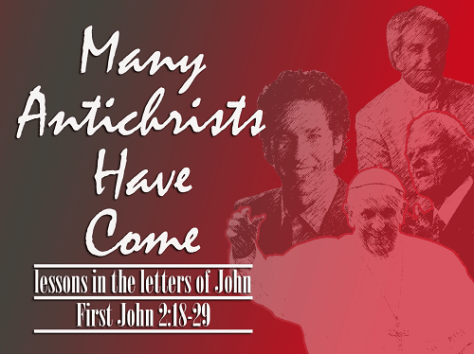
Many Antichrists Have Come

1 John 2:18-29

I. THE ANTICHRISTS

    A. Who is an Antichrist? (1 John 2:18; 2 John 9-11)
    B. What does an Antichrist do?

      1. Disobeys (1 John 2:19)
      2. Denies (1 John 2:22-23; John 5:22-23)
      3. Deceives (1 John 2:26; 4:1; Acts 17:11; 20:29-30)

II. THE ANOINTED

    A. Word play: anti-christoi (1 John 2:18) vs. christoi (1 John 2:20)
    B. Abide in the truth (1 John 2:24; Luke 12:8-9; Acts 2:42)
    C. Abide in the Son and the Father (1 John 2:24-25; Mark 10:29-30)

III. THE ASSURANCE

    A. What does inspiration teach? (1 John 2:27; 2 Timothy 3:16-17)
    B. Confidence at His coming (1 John 2:28; Acts 4:13)

      1. Prayer of Peter and John (Acts 4:29)
      2. Prayer of Paul (Ephesians 6:18-19)

    C. Roy H. Lanier, Jr.: “As the father in the family is righteous, so are the children. It is a family characteristic.” (1 John 2:29; 2 Timothy 2:11-13)

A Study of the Sermon on the Mount

I consider it a privilege to teach God’s Word and I am grateful for the opportunities that are presented to me by the Point Pleasant church of Christ. This past Sunday, I wrapped up an 11-lesson study of the Sermon on the Mount with the middle school class. There are many rich lessons to be found in Christ’s masterpiece.

Throughout my preparation, I made use of the commentaries of several scholars in the Lord’s church. Their works are available online at the following links:

My notes are presented here for your use as an aid in personal or class studies. Use them as you see fit.

Minor updates were made to pages 33-35 to correct typographical errors and make a statement clearer. If you have already downloaded a copy, please delete and re-download below. If you come across any typos or if anything needs further clarification, please let me know.

downloadClick here to download A Study of The Sermon on the Mount: Class notes compiled by Jason T. Carter (PDF format).

Commitment to the Lord

Commitment to the Lord sermon

Mark 12:28-30

I. LOVE GOD WITH ALL YOUR HEART

    A. More than just words (John 14:15; 1 John 5:3)
    B. Full dedication (Matthew 6:24)

II. LOVE GOD WITH ALL YOUR SOUL

    A. Barnes: “to be willing to give up the life to him, and to devote it all to his service; to live to him, and to be willing to die at his command”
    B. Stephen (Acts 7:57-60)
    C. James (Acts 12:1-2)
    D. Smyrna (Revelation 2:10)

III. LOVE GOD WITH ALL YOUR MIND

    A. Train our minds (Acts 17:11)
    B. Realize the importance of God’s Word (2 Timothy 3:16-17; 2 Timothy 2:15)
    C. Realize the importance of fellowship (Hebrews 10:23-25)
    D. Realize the importance of obedience (Hebrews 2:3; 1 John 5:3)

IV. LOVE GOD WITH ALL YOUR STRENGTH

    A. Commitment (Romans 12:1)
    B. Strength comes from the Lord (Philippians 4:13)

Love Not The World

love-not-the-world

1 John 2:15-17

I. “DO NOT LOVE THE WORLD” (1 John 2:15)

    A. What type of “love”? Agape – sacrificial love
    B. What is “the world”?

      1. God’s creation (John 1:10)
      2. Mankind (1 John 2:2; John 3:16)
      3. “The mass of unbelievers hostile to Christ and resisting salvation” (John 15:18; 1 John 3:1; 4:4-5)

    C. What is your primary concern? (Romans 12:2)
    D. “…or the things of the world” (Mark 10:17-22)
    E. “…the love of the Father is not in him” (Matthew 6:24; Romans 8:5)

II. THE TEMPTATIONS OF THE WORLD (1 John 2:16)

    A. “The three avenues of temptation”

      1. The lust of the flesh — the lust of the eyes — the pride of life
      2. Good for food — pleasant to the eyes — make one wise (Genesis 3:1-6)
      3. Stones to bread — riches of the world — heavenly protection (Matthew 4:1-11)

    B. How to avoid the lust of the flesh, the lust of the eyes, and the pride of life (Galatians 5:16-24)

III. THE FLEETING NATURE OF THIS WORLD (1 John 2:17)

    A. The world is fleeting, temporary, non-permanent (2 Corinthians 4:18; 2 Peter 3:10-12)
    B. “God himself is eternal; and those who abide in him, will share in his eternal nature” (Guy N. Woods)

The Joy of Mercy

In the Sermon on the Mount, Jesus delivered several beatitudes, or “blessed” sayings. The Lord taught His disciples how they could be truly happy by identifying character traits of the joyous. Among those exhortations, Jesus said, “Blessed are the merciful, for they shall obtain mercy” (Matthew 5:7). The wise man in Proverbs 14:21: “He who despises his neighbor sins; but he who has mercy to the poor, happy is he.” Extending mercy to those around us will result in joy.

It has been said that grace is getting what you do not deserve, while mercy is not getting what you do deserve. How many people can say they deserve salvation? The prophet Isaiah said, “But your iniquities have separated you from your God; and your sins have hidden His face from you, so that He will not hear” (Isaiah 59:2). The apostle Paul reminds us that “all have sinned and fall short of the glory of God” (Romans 3:23). As one of my Bible teachers often said, “You can’t get ‘all’-er than ‘all.’” In other words, there is no one excluded from the word “all.”

Without God’s mercy, we are without hope. But God provides mercy to those who extend mercy. Conversely, those who are unmerciful toward their brother will face harsher judgment from the Almighty. “For judgment is without mercy to the one who has shown no mercy. Mercy triumphs over judgment” (James 2:13).

When Peter asked how many times he should forgive his brother in Matthew 18, suggesting that seven times should surely be sufficient, Jesus answered, “I do not say to you, up to seven times, but up to seventy times seven.” He then told a parable about an unmerciful man who, despite the great mercy shown to him, was unforgiving of his brother. His master “delivered him to the torturers until he should pay all that was due to him.” Jesus concluded, “So My heavenly Father also will do to you if each of you, from his heart, does not forgive his brother his trespasses.”

The bottom line is this: if you crave God’s mercy, be merciful to your fellow man!

Our Love of God and Man

c3l17ikwcaa3dwy

1 John 2:3-11

I. DO YOU KNOW GOD?

    A. Man’s relationship to the Almighty (1 John 2:3; John 12:48)
    B. Self-deception (1 John 2:4; Matthew 7:21-23; 1 John 1:6,8,10; Titus 1:11,16)
    C. Perfected love of God (1 John 2:5; Matthew 5:43-48)

II. DO YOU ABIDE IN HIM?

    A. Walk just as He walked (1 John 2:6; John 8:12; 1 Corinthians 11:1; Ephesians 5:1-2)
    B. The old commandment, made new (1 John 2:7-8; John 13:34-35)

III. THE DANGERS OF DARKNESS

    A. Is it possible to follow Christ while in darkness? (1 John 2:9; John 8:12; Romans 13:12; 1 Thessalonians 5:5)
    B. Our love of man (1 John 2:10; 1 Corinthians 13:1-8a; John 15:9-10; 13:34; Philippians 2:3)
    C. Hatred causes blindness (1 John 2:11)

Obedience Requires Humility

Paul, Silas, and their fellow workers in the Lord encountered a great number of people on their missionary journey. Some of those people received their teachings, while others rejected the message of God. When they arrived in Philippi, the missionaries went to the riverside where a group of spiritually-minded women were praying on the Sabbath.

One of those women was named Lydia. As Paul taught the truth of Jesus Christ, Lydia’s heart was opened and she heeded his words. “And when she and her household were baptized, she begged us, saying, ‘If you have judged me to be faithful to the Lord, come to my house and stay.’ So she persuaded us” (Acts 16:15).

What a precious response to the Word of God. Luke does not record any arguing over the doctrine. Lydia did not make excuses for her shortcomings, nor did she “agree to disagree” with what Paul taught. She heard, she believed, and she was baptized.

How do you feel when you find out you have been wrong about something? Perhaps your boss showed you a more efficient way to do your job. Do you resist the change just because you have been doing it your way for years? Or do you recognize that there is a better way, and adjust accordingly?

Spiritually speaking, the new covenant of Jesus is “a better covenant” than the old Law of Moses, offering “a better hope” (Hebrews 7:19,22; 8:6). Christianity is better than any other religion, because it is the only path to salvation. Jesus Christ, and only Jesus Christ, is “the way, the truth, and the life.” He said, “No one comes to the Father except through Me” (John 14:6).

The church must follow the Word of God, and only the Word of God. No denominational creeds, no catechisms, nothing more and nothing less than the inspired Word. It is not arrogance, but rather humility, to recognize that we cannot improve upon His revelation. The Father said of Jesus, “This is My beloved Son. Hear Him!” (Luke 9:35).

The Home and Evangelism

The Home and Evangelism

I. The Great Commission

    A. “all nations” (Matthew 28:19-20)
    B. “all the world…every creature” (Mark 16:15)
    C. Where did they start? “in Jerusalem…Judea…Samaria…the end of the earth” (Acts 1:8)
    D. We start where we are with those we care about most – our immediate sphere of influence – our home

II. Teaching our children

    A. Commanded in the Old Testament (Deuteronomy 6:6-9; Proverbs 22:6)
    B. Commanded in the New Testament (Ephesians 6:4)
    C. Elders’ children are to be “faithful…not accused of dissipation or insubordination” (Titus 1:6)

III. The influence of godly parents and spouses

    A. As an example to children/grandchildren – Timothy’s grandmother Lois and mother Eunice (2 Timothy 1:5; 3:14-15)
    B. As an example to unbelieving spouses (1 Peter 3:1-2; 1 Corinthians 7:12-16)

IV. Examples of family evangelism

    A. Andrew brought Peter to Jesus (John 1:40-42)
    B. Inviting evangelists into one’s home

      1. Cornelius (Acts 11:13-14)
      2. Lydia (Acts 16:14-15)
      3. The Philippian jailer (Acts 16:30-34)
      4. Crispus (Acts 18:7-8)

V. How do we evangelize in our family today?

    A. Pray for them and for yourself for opportunities (Ephesians 6:18-19)
    B. Study to be prepared to answer their questions (2 Timothy 2:15; 1 Peter 3:15)
    C. Look for opportunities to teach
    D. Invite them to hear other teachers (Friends & Family, Gospel Meetings, VBS, weekly worship services and classes)
    E. Set up a home Bible study – if you are not comfortable leading this yourself, there are several others in the congregation that are willing and able to teach privately

Useful

When Barnabas and Saul embarked on their first missionary journey, John Mark traveled with them as their assistant (Acts 13:5), but he did not stay with the mission long (Acts 13:13). We are not told the precise reason for Mark’s departure, but he violated Paul’s trust when he left.

In fact, Paul’s distrust was so great that he refused to give Mark another chance on his second missionary trip, despite Barnabas’ suggestion. “Then the contention became so sharp that they parted from one another” (Acts 15:39).

Paul was focused on the work and strengthening the churches that were established during the first trip, and did not want to be distracted by Mark’s shortcomings; Paul did not want to risk a second abandonment. Barnabas, on the other hand, wanted to encourage Mark in his labors for the Lord and provide him the emotional support he needed in his service.

How many people disappear from the Lord’s service today? What should we do when we see someone drifting away from the faith? Paul himself wrote that we should “restore such a one in a spirit of gentleness, considering yourself lest you also be tempted” (Galatians 6:1).

When we mess up, we may disappoint family and friends, but that does not mean we are forever useless. It may take time to rebuild trust, but if we are diligent and faithful, it can be accomplished, just as Mark eventually won back Paul’s trust (2 Timothy 4:11).

It starts small. We should not expect someone to entrust us with a major task if we have not proved ourselves with simpler things. Read Jesus’ parable of the talents in Matthew 25:14-30. What does Jesus say to those who were faithful and fruitful? What does He say to the man who did nothing with that which was entrusted to him?

It is very important that we serve the Lord to the best of our ability and not give up. But if we do stumble, know that we can turn ourselves around and become useful to Him again.

Walking in God’s Light

walking in Gods light 1973 Topps

1 John 1:5-2:2

I. “GOD IS LIGHT AND IN HIM IS NO DARKNESS AT ALL” (1 John 1:5)

    A. God is light

      1. The Father of lights (James 1:17)
      2. The Creator of light (Genesis 1:3)
      3. Dwells in unapproachable light (1 Timothy 6:16)
      4. Calls us into His marvelous light (1 Peter 2:9)

    B. Darkness is the realm of Satan (Ephesians 6:11-12; Colossians 1:3; Ephesians 5:8)

II. SIX “IF” STATEMENTS

    A. “If we say that we have fellowship with Him, and walk in darkness, we lie and do not practice the truth.” (1 John 1:6; Matthew 6:2,5,16; Galatians 2:11-13)
    B. “But if we walk in the light as He is in the light, we have fellowship with one another, and the blood of Jesus Christ His Son cleanses us from all sin.” (1 Jn 1:7)
    C. “If we say that we have no sin, we deceive ourselves, and the truth is not in us.” (1 John 1:8; Galatians 6:3; James 1:22)
    D. “If we confess our sins, He is faithful and just to forgive us our sins and to cleanse us from all unrighteousness.” (1 John 1:9)
    E. “If we say that we have not sinned, we make Him a liar, and His word is not in us.” (1 John 1:10; Romans 3:23)
    F. “And if anyone sins, we have an Advocate with the Father, Jesus Christ the righteous.” (1 John 2:1a)

III. WHAT WE HAVE AS A RESULT OF WALKING IN GOD’S LIGHT

    A. Fellowship (1 John 1:7)
    B. Cleansing (1 John 1:7,9; Romans 5:9; Ephesians 1:7; 1 Peter 1:18-19; Ephesians 2:13; Colossians 1:20)
    C. Forgiveness (1 John 1:9)
    D. An Advocate who serves as the propitiation (1 John 2:1-2; 4:9-10)

But when they believed Philip as he preached the things concerning the kingdom of God and the name of Jesus Christ, both men and women were baptized. (Acts 8:12)