“This is a Hard Saying; Who Can Understand It?”

John 6:48-60

I. THE OFFENSIVE TEACHING OF CHRIST

    A. The Jews refused to believe (John 6:41-42)
    B. We can partake of the bread of life because of His sacrifice on the cross (John 6:48-51; Philippians 2:5-8)
    C. The literal interpretation (John 6:52)
    D. Complete commitment: 24/7/365 (John 6:53-58)

II. THE DISCIPLES ASK A DANGEROUS QUESTION

    A. “This is a hard saying; who can understand it?” (John 6:60)

      1. “Who can hear it?” (KJV)
      2. “Who can listen to it?” (ESV)
      3. “Who can accept it?” (NIV)

    B. A discouraging question – what’s the point in even trying? (Ezekiel 33:8-9; Galatians 6:1-10; James 5:19-20)

III. THE WORDS OF JESUS CAN SAVE

    A. Our responsibility to evangelize (John 6:63; Matthew 28:19-20; 2 Timothy 2:2)
    B. It is not our ability, but God’s power (Romans 1:16; 1 Corinthians 3:7)
    C. Consider what the Word does

      1. “Build you up and give you an inheritance” (Acts 20:32)
      2. We are “born again…through the word of God” (1 Peter 1:22-23)
      3. “Able to save your souls” (James 1:21)

    D. Is anyone too corrupt to be saved? (1 Corinthians 6:9-11)

Watch a video of this lesson.

On NBC’s Rise and the Christian’s vigilance

          Christians must be aware of the world around them. Inspiration teaches, “Be sober, be vigilant; because your adversary the devil walks about like a roaring lion, seeking whom he may devour” (1 Peter 5:8). Our awareness of the world will help to guard us against falling prey to Satan’s schemes, and prepare us to help others find God’s truth.
          NBC premiered a new program called Rise in March. The show focuses on Lou Massuchelli, an English teacher put in charge of his high school’s drama club. His first act is to announce the production of the controversial musical, Spring Awakening, which addresses several issues of teenage sexuality.
          Rise includes a male homosexual student, a transgender female transitioning to male, and a straight male who is cast in a role that requires him to kiss another male. All of these are presented as completely normal, acceptable lifestyles to most of the other characters. The few that object are portrayed as narrow-minded people. Showrunner Jason Katims released a statement in which he affirmed the producers are “firmly committed to LGBTQ inclusion” and that Rise “portrays positive depictions of LGBTQ characters and stories…with honesty and sensitivity.”
          In a recent episode, a parent asked the teacher, “What do you believe in?”
          Lou responded, “I believe in the kids I teach. I believe in the truth. I believe in helping them to grow up in the sun and not in the shadows,” further reinforcing the character’s view that homosexuality and transgenderism should be accepted by everyone.
          I am reminded of the prophet who cried, “Woe to those who call evil good, and good evil; who put darkness for light, and light for darkness; who put bitter for sweet, and sweet for bitter!” (Isaiah 5:20).
          Fornication — whether heterosexual or homosexual — is wrong, regardless of age. Transgenderism is wrong. Brother Ben Giselbach published an informative article about transgenderism in 2015 on his website, “Plain Simple Faith” (plainsimplefaith.com/2015/06/transgenderism).
          Christians, be aware that many of your co-workers (adults) and classmates (youngsters) believe in the acceptance of deviant sexual behaviors. Be ready to defend the Biblical truth on these matters (1 Peter 3:15; Jude 3).

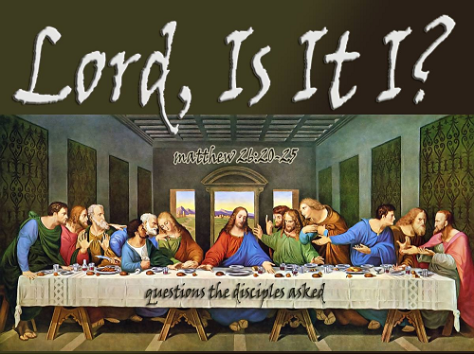
“Lord, Is It I?”

Matthew 26:20-25

I. THE SETTING

    A. Jesus’ startling revelation (Matthew 26:21)
    B. The fulfillment of prophecy (Psalm 41:9; cf. John 13:18)

II. THE REACTION OF THE DISCIPLES

    A. The innocent eleven were “exceedingly sorrowful” (Matthew 26:22; cf. John 13:22; Luke 22:23)

      1. Humble self-examination (Matthew 26:22; Mark 14:19)
      2. Reaction to “this night” (Matthew 26:31, 33, 35)

    B. Judas was neither innocent nor humble (Matthew 26:14-16, 25)

III. APPLICATION FOR TODAY

    A. The duty of elders (Acts 20:28-30; Titus 1:10-11)
    B. The preaching of sound doctrine (2 Timothy 2:3-4)
    C. The obligation of the entire church (Matthew 28:19-20)

Watch a video of this lesson.

On Stephen Hawking and the reality of God

          The Hebrews writer penned, “It is appointed for men to die once, but after this the judgment” (Hebrews 9:27).
          Stephen Hawking passed from this life into eternity on Wednesday, March 14, 2018. As of 2011, Mr. Hawking did not believe the words of inspiration. In an interview with The Guardian, quoted by USA Today, the physicist said, “I regard the brain as a computer which will stop working when its components fail. There is no heaven or afterlife for broken down computers; that is a fairy story for people afraid of the dark.”
          God blessed Mr. Hawking with intelligence, but the man refused to use that blessing to observe the Almighty’s creation all around Him and seek the designer of it all. In The Grand Design, published in 2010, Mr. Hawking wrote, “Spontaneous creation is the reason there is something rather than nothing, why the universe exists, why we exist. It is not necessary to invoke God to light the blue touch paper and set the universe going.”
          Sadly, to the best of my knowledge, Mr. Hawking never shed his self-proclaimed atheism. As Christians, we must mourn not only the loss of his brilliant mind but also the eternal state of his soul. We cannot rejoice in the eternal condemnation of the unbelieving, but trust in the righteousness of God. We need to share the desire of the Lord, who is “not willing that any should perish but that all should come to the repentance” (2 Peter 3:9) and strive to reach those with whom we have some influence.
          Mr. Hawking said, “Remember to look up at the stars and not down at your feet. Try to make sense of what you see and wonder about what makes the universe exist.” Friends, all the answers that we need are found in the Holy Scriptures.
          “If then you were raised with Christ, seek those things which are above, where Christ is, sitting at the right hand of God. Set your mind on things above, not on things on the earth. For you died, and your life is hidden with Christ in God” (Colossians 3:1-3).

“Lord, do you want us to command fire to come down from heaven and consume them?”

Luke 9:51-56

I. THE SETTING (Luke 9:51-53)

    A. The Feast of the Tabernacles (Luke 9:51-52)
    B. The refusal of the Samaritans (Luke 9:52-53; contrasted with John 4:39-41)

II. THE REACTION OF JAMES AND JOHN (Luke 9:54)

    A. Their question shows their attitude (Luke 9:54; Proverbs 14:29; Mark 3:17)
    B. Positives

      1. They ask permission
      2. They know their history (2 Kings 1:2-12)

    C. However, they misapplied the history

      1. The Samaritans were not idolatrous
      2. The Samaritans still had potential (Acts 8:1,4-8,14-17)

III. THE RESPONSE OF JESUS (Luke 9:55-56)

    A. The Lord’s mission (Luke 9:55-56 KJV/NKJV; John 3:16-17; Luke 19:1-10)
    B. Our mission must be the same as Christ’s – whether face-to-face or on Facebook
    C. When rejected, “they went to another village” (Luke 9:56)
    D. Be prepared when someone comes around and is later ready to hear the truth (1 Peter 3:15)

Watch a video of this lesson.

On Billy Graham and the “importance” of baptism

          Facebook was flooded with posts about Billy Graham as the news of his passing spread on Wednesday. Many shared memories of hearing the popular preacher, others recounted some of his achievements in religion. He was commended by some and criticized by others.
          Those who criticized Mr. Graham’s preaching, specifically his failure to preach the “whole counsel of God” (Acts 20:27), were themselves rebuked with the statement, “God alone will judge!” In truth, no mortal man can preach anyone into heaven or condemn anyone to hell. It is God and God alone who knows all there is to know about a man (2 Corinthians 5:10). However, the Scriptures also teach that we can identify false teachers “by their fruits” (Matthew 7:15-20).
          If you continue reading in Matthew 7:21-23, Jesus talks about religious people who claimed to do good works, but who would be denied entrance to the kingdom of heaven. Despite all of their good works, Jesus says, “I never knew you; depart from Me, you who practice lawlessness!”
          Mr. Graham’s teaching was good, up to a point. He stressed the importance of faith. He extolled the value of morality. However, he stopped short. Concerning baptism, he said, “I believe baptism is important, and I have been baptized. But I think we violate the Scriptures when we make baptism the prime requirement for salvation.”
          First, note that Mr. Graham accuses some of making baptism “the prime” requirement. Brethren, baptism must be based upon faith in Christ as the Son of God and coupled with repentance. It is no more or less “prime” than any of God’s commands.
          Second, compare Mr. Graham’s opinion (that baptism is “important”) to the inspired Word. Read Mark 16:16; Acts 2:38; 22:16; 1 Peter 3:21; Galatians 3:27; Romans 6:3-6. Do you get a sense of mere importance in those passages, or is it directly related to salvation?
          Many have sadly been deceived by Mr. Graham’s teachings. May we all strive for faith in the Word of God rather than the words of uninspired men as we seek to obey our Father.

“Why Could We Not Cast It Out?”

Mark 9:14-29

I. THE IMPORTANCE OF FAITH

    A. “O faithless generation” (Mark 9:19; cf. Matthew 17:20)
    B. True, Biblical faith is based on the Word of God (Hebrews 11:6; Romans 10:17)
    C. “Lord, I believe; help my unbelief!” (Mark 9:24)

II. THE POWER OF PRAYER

    A. We can, by God’s will, reach more people with God’s truth, so long as we continue to kneel before God’s throne (Romans 1:16; 1 Corinthians 3:6)
    B. Do not ask God to answer a prayer that violates His Word or His character (1 John 5:14-15)
    C. Exhibit humility in prayer (James 4:3,6)

III. THE HUMILITY OF FASTING

    A. Old Testament examples (Ezra 8:21,23; Psalm 35:13)
    B. New Testament examples (Acts 13:2-3; 2 Corinthians 6:5; 11:27)
    C. Proper motivation (Matthew 6:16-18)

The Minor Prophets

John the Baptist

The inspired apostle Peter wrote that “prophecy never came by the will of man, but holy men of God spoke as they were moved by the Holy Spirit.” The final twelve books in the Old Testament fall under the heading of “Minor Prophets,” simply meaning that the length of their writings was shorter than Isaiah, Jeremiah, Ezekiel, and Daniel. The messages they spoke were not minor, and today in the Christian age, we can still learn from the principles espoused by these holy men of God.

Feel free to use these brief notes in your private studies or with a class. Keep in mind this is just a general overview of these prophets and lessons we can learn today; make use of the resources listed at the end of this book for deeper study.

PDFClick here to download A Study of The Minor Prophets: Class notes compiled by Jason T. Carter (PDF format).

The Minor Prophets: Malachi

The Minor Prophets Hosea

THE MINOR PROPHETS // MALACHI

I. Historical background

    A. Around 450 B.C. (Coffman); 445-432 B.C. (Hailey); 460-425 B.C. (Waddey)
    B. “The time in which Malachi prophesied is determined by material within the book rather than from the opening lines of the book as has been true with earlier prophets. It is a time of careless priests (Mal. 1:6-2:9), skepticism (Mal. 3:14; 2:17), and of inter-marriage (Mal. 2:11-16). The temple is evidently completed and sacrifices are being offered (Mal. 1:7-10). Judah is under a governor (Mal. 1:8). Edom has been destroyed (Mal. 1:1-5).” (Lewis)
    C. “The book itself does not give the date of its writing. However, most scholars agree that the writer of the book dealt with much the same problems as were prevalent during the time of Ezra and Nehemiah….The Temple was rebuilt about 520-516 B.C. Then about 60 years later (around 456 B.C.) Ezra had come home from Babylon to Jerusalem to help encourage and reorganize the nation. Then, about 13 years later (around 444 B.C.), Nehemiah came to Jerusalem and directed the rebuilding of the wall. This seems to have been close to the time of the conditions and events described in Malachi. Thus it seems that the Jews had been home about 100 years in Malachi’s time.” (Warren)
    D. “For a full picture of the conditions in Judea during the period one should read Ezra 7-10 and the complete Book of Nehemiah.” (Hailey)

II. About the prophet

    A. “Nothing is known of the life of the author of this book. Some scholars even doubt that we know his name. They contend that since ‘Malachi,’ which is the Hebrew word for ‘my messenger,’ appears nowhere else as a proper name it should not be considered to be one in connection with this book.” (Warren)
    B. Some object to the supposed anonymity of the book, including Coffman and Hailey. “No other OT prophecy is anonymous, nor may we reasonably supposed Malachi to be an exception.” (Coffman)
    C. Malachi “might have meant My Angel or Messenger, or it may be taken as an adjective Angelicus. Either of these meaning would form a natural name for a Jewish child, and a very suitable one for a prophet.” (Smith)

III. Lessons for today

    A. God hates divorce (2:16)

      1. Hatred is a strong emotion, but it is applied to several specific sinful attitudes and actions (Proverbs 6:16-19; Deuteronomy 12:29-31)
      2. “Such a vigorous warning and exhortation from the Lord in a former decadent and permissive age should not be silenced; its principle should be heralded to the ends of the earth in our own time.” (Hailey)
      3. Single Christians should take great care in choosing a mate, since God’s intention for marriage is a life-long commitment (Matthew 19:4-6; 1 Corinthians 7:10-13)
      4. “Disregard for marriage vows is disastrous for the individual, society and the nation.” (Waddey)

    B. “God is never satisfied with partial, or incomplete, service.” (Woods)

      1. “Malachi teaches that although ritual may be important in religion, it is not an end in itself. Ritual is only of value when it expresses a deep and sincere spiritual worship unto God.” (Hailey)
      2. The people of Malachi’s day were not doing all that they should or could in giving back to God (1:8; 3:8-10; cf. Leviticus 22:18-20)
      3. “Notice that they were not robbing God in the sense that they were taking money, but they simply were not giving as they had been commanded!” (Warren)
      4. “Every spiritually minded person who ever lived instinctively accepted the principle that, to God one must give the very best….The reprobate priesthood of Malachi’s times were accepting the sick, the lame, and the blind, and doing many other things forbidden.” (Coffman)
      5. Does God expect more us to do or give than we are able? No, but neither should we underestimate how much we are able to do or give! (2 Corinthians 8:9-15)
      6. When we commit to something, we must be sure to follow through once we have the ability (Ecclesiastes 5:4-5)

    C. Our attitude toward correction should be one of repentance (3:16)

      1. Malachi preached against the sins of the people, resulting in a change of heart and life in “those who feared the Lord”
      2. “Malachi foresees the repentance of some, though not all the people. They would speak with one another. No doubt their speaking would concern the need for repentance, for genuine worship. As always, the fear of Jehovah would prove the beginning of wisdom for Jehovah would hear and remember.” (Gill)
      3. Today, we must listen to the preaching of the Word, even when it is uncomfortable to hear (2 Timothy 4:2), and respond appropriately (James 1:21-25)

Resources
Coffman, James Burton. (1983). Commentary on the Minor Prophets, Volume 4: Zechariah and Malachi. Austin, TX: The Firm Foundation Publishing House. [Textual commentary excluding introductory notes on each book available online at https://www.studylight.org/commentaries/bcc/malachi.html]

Gill, Clinton R. (1971). Minor Prophets: A Study of Micah through Malachi. Joplin, MO: College Press. [Online at http://www.restorationlibrary.org/library/BSTSMP/BSTSMP_SIPDF.pdf]

Hailey, Homer. (1972). A Commentary on the Minor Prophets. Grand Rapids, MI: Baker Book House.

Lewis, Jack P. (1966). Minor Prophets. Austin, TX: R.B. Sweet Co., Inc.

Smith, George Adam. (1906). The Book of Twelve Prophets, Vol. II. New York, NY: A.C. Armstrong and Son. [Online at https://archive.org/stream/bookoftwelveprop028005mbp]

Waddey, John. (2011). The Testimony of the Twelve Minor Prophets. Delight, AR: Gospel Light Publishing Company. [Online at http://www.restorationlibrary.org/library/TTMP/TTMP_SIPDF.pdf]

Warren, Lindsey D. “The Living Message of Zechariah.”(1977). The Living Messages of the Books of the Old Testament. Garland Elkins and Thomas B. Warren, editors. Jonesboro, AR: National Christian Press, Inc.

Woods, Guy N. (1957). Adult Gospel Quarterly: January, February, March 1958. Nashville, TN: Gospel Advocate Company.

The Minor Prophets: Zechariah

The Minor Prophets Hosea

THE MINOR PROPHETS // ZECHARIAH

I. Historical context

    A. “In the eighth month of the second year of Darius” (1:1); beginning in late 520 B.C. (Coffman; Gill; Howard; Lewis; Waddey); “chapters 9-14, is generally thought to be from a later period of his ministry” (Waddey)
    B. “Darius, after fighting some nineteen battles, put down the rebellious challenges of his authority; and there was nothing to hinder the Jews rebuilding of the Temple except their own lethargy. Zechariah, along with Haggai, whose prophetic career began some two months earlier, successfully led the people in rebuilding it. It is altogether possible that Zechariah saw the rebuilt temple completed in 516 B.C., and that he lived and prophesied long after that event.” (Coffman)
    C. “The first eight chapters consist of the prophecies dated according to the reign of King Darius during his second, third and fourth years of rule….Chapters 9-14, however, find us in an altogether new setting—one of sharp contrast to the first eight chapters. There is no more reference to the construction of the temple; heathen forces not even mentioned before are now detailed; war seems just a breath away and the love and peace and tranquility seems to have vanished.” (Howard)
    D. “The book of Zechariah may be thought of as a sequel to Haggai. The temple was begun and constructed in the midst of conflict, but it would be completed. Zechariah looks beyond the immediate temple to the Messiah and the spiritual temple of God, and to the final consummation of God’s purpose in the glory of the Messiah and His rule. This would be accomplished amid great opposition, but Jehovah would fight for His people and give them victory.” (Hailey)

II. About the prophet

    A. “The name Zechariah means ‘Jehovah remembers,’ or ‘Jehovah has remembered.” (Howard)
    B. “In contrast to Haggai, who was a ‘layman,’ Zechariah was a Levitical priest, and a member of one of the outstanding priestly families.” (Gill)
    C. “The writings of Zechariah reflect an engaging personality, a simple, hearty, practical man. His spirit was dedicated to love, justice and man’s need for freedom and a happy home.” (Waddey)
    D. Some believe Christ speaks of the prophet’s death in Matthew 23:34-35 (Howard), while others believe it is a different Zechariah to whom the Lord refers (Coffman, Hailey, Lewis, Waddey)

III. Lessons for today

    A. It was always in God’s plan to include other nations in His kingdom (2:3-4, 11; 9:9-10)

      1. “‘Jerusalem shall be inhabited without walls…’ This never applied to the literal Jerusalem, except for part of a century before the people were able to rebuild the walls. The simple meaning is that God’s eventual city, as realized in the Church of Jesus Christ, shall not be a fortified citadel, but a world-wide fellowship that no walls could limit or contain.” (Coffman)
      2. “‘In that day…’ is a phrase often associated in the prophecies with ‘the times of the Messiah.’” (Coffman)
      3. “This projects the prophecy into that distant day when Messiah would come to dwell among the Hebrews (John 1:14) and would invite all nations to become his disciples (Matt. 28:19). Gentiles would have access to the divine promise through the gospel (Eph. 3:6).” (Waddey)
      4. “The Lord looks beyond the physical descendants of Israel to a nation that includes some from among all the nations, Gentiles as well as Jews. In the midst of such a people Jehovah will dwell.” (Hailey)

    B. The importance of following God’s will in worship (chapters 7 and 8)

      1. The people had instituted a fast seventy years prior to remember and mourn the destruction of the temple (7:3)

        a. Other fasts had also been established at the same time in different months (8:19)
        b. “The four fasts the Jews have been keeping in memory of Nebuchadnezzar’s coming against Jerusalem (tenth month), of the breach made in the wall (fourth month), of the burning of the house of Jehovah (fifth month), and of the murder of Gedaliah (seventh month)…” (Hailey)
        c. “This preoccupation with weeping, mourning, and fasting represented a radical change in Jewish religious life. Weeping and sorrow replaced hymns and thanksgivings; and Watts affirmed that, ‘The practice has survived into this century at the so-called “Wailing Wall” in Jerusalem.’” (Coffman)

      2. The fact is that God only established one fast for the Jews to observe on a continual basis: the Day of Atonement, observed on the tenth day of the seventh month (Leviticus 23:27-32)

        a. The fast mentioned in Zechariah “was not of godly sorrow for past offences, but of selfish regret for loss of their country and their liberty. They pitied themselves, but they had not learned to fear Jehovah.” (Hinckley, quoted by Coffman)
        b. “Zechariah reminds them that this fasting had been done to bewail their exile and ruin. It had not come from divine commandment; therefore, it did not possess the deepest spiritual meaning.” (Howard)
        c. It was instituted by the people for the wrong reasons, not by God nor for God (7:5)

      3. We are warned against binding things on others that are not authorized or commanded by God

        a. Matthew 15:9; Colossians 3:17
        b. While we have examples of Christians fasting in Acts (13:2-3; 14:23), we are not commanded to observe a fast collectively as a church at appointed times
        c. When we fast, our motivation must be pure (Matthew 6:17-18), and when done in a marriage relationship, fasting must be done with mutual consent between husband and wife (1 Corinthians 7:5)
        d. It is an individual decision, and should not be bound on others
        e. “Fasting, for the Christian, is strictly a voluntary matter. It should arise out of a feeling of intense need, not as a result of mere formality.” (Jackson)

    C. The existence of Christ before He “became flesh and dwelt among us” (John 1:14)

      1. The Angel of the Lord appears throughout the Old Testament, going all the way back to Genesis; in the NKJV the word “Angel,” when used in this context, is generally capitalized indicating the translators believed Him to be Deity
      2. This Angel of the Lord is featured prominently in the book of Zechariah
      3. “The following observations will establish that this mighty angel was no less than the Word of God, the preincarnate Christ. The angel of Jehovah told Moses that his name was ‘I AM THAT I AM.’ Jesus also claimed that he was I AM (John 8:58).

      “The angel led Israel through the wilderness and provided their needs (Ex. 14:19-20). Moses reported that Jehovah directed Moses to smite the rock that the people might drink in the desert. But Paul tells us that the rock they drank of was Christ (1 Cor. 10:24).

      “In the Book of Joshua, the angel is the prince or leader of Jehovah’s host or army (5:14). In Revelation 19, we see the army of heaven and its notable leader. Then John sees his name which is ‘The Word of God’ (19:11-16). In his Gospel, John identifies the Word of God as the only begotten of the Father, who became flesh (John 1:1-4,14).

      “The angel told Manoah that his name was wonderful (Judg. 13:16-18). Isaiah, in his famous prophecy of Messiah said, ‘His name shall be called Wonderful…’ (9:6).

      “Isaiah calls him ‘The angel of God’s presence,’ which means ‘of his face’ (63:9). The Hebrews writer says Christ is ‘the very image of his (God’s) substance’ (1:3).”…

      “The angel of Jehovah can be worshiped (Josh. 5:4). No mere man or created angel can be worshiped acceptably (Acts 10;25,26; Rev. 22:-8-9). But Jesus commonly accepted the worship of men (Matt. 28:17)….

      “These appearances of the angel of Jehovah, in ancient times, are called theophanies, i.e., when God assumes the form of an angel or a man in order to speak and act visibly and audibly to men, to provide them some revelation or guidance.” (Waddey)

Resources
Coffman, James Burton. (1983). Commentary on the Minor Prophets, Volume 4: Zechariah and Malachi. Austin, TX: The Firm Foundation Publishing House. [Textual commentary excluding introductory notes on each book available online at https://www.studylight.org/commentaries/bcc/zechariah.html]

Gill, Clinton R. (1971). Minor Prophets: A Study of Micah through Malachi. Joplin, MO: College Press. [Online at http://www.restorationlibrary.org/library/BSTSMP/BSTSMP_SIPDF.pdf]

Hailey, Homer. (1972). A Commentary on the Minor Prophets. Grand Rapids, MI: Baker Book House.

Howard, V.E. “The Living Message of Zechariah.”(1977). The Living Messages of the Books of the Old Testament. Garland Elkins and Thomas B. Warren, editors. Jonesboro, AR: National Christian Press, Inc.

Jackson, Wayne. “Is Fasting for Christians Today?” ChristianCourier.com. [http://www.christiancourier.com/articles/231-is-fasting-for-christians-today]

Lewis, Jack P. (1966). Minor Prophets. Austin, TX: R.B. Sweet Co., Inc.

Waddey, John. (2011). The Testimony of the Twelve Minor Prophets. Delight, AR: Gospel Light Publishing Company. [Online at http://www.restorationlibrary.org/library/TTMP/TTMP_SIPDF.pdf]

But when they believed Philip as he preached the things concerning the kingdom of God and the name of Jesus Christ, both men and women were baptized. (Acts 8:12)