Read the New Testament in a year, one chapter a day, five days a week

Day 131/260: Read Matthew 6

Motivations are important, aren’t they? In the famous Sermon on the Mount, Jesus talks a lot about motivations. In the sixth chapter, He tells His followers that if their motivations are not proper, their reward will be non-existent.

You want to do good by giving to charity? Don’t seek praise for doing it. You want to pray to God? Don’t do it so everyone else can hear you. You want to fast? Don’t make a show of it. If you do these things to glorify God, that’s good; if you do these things to receive the praise of men and to show how holy you are, then that is all you will get out of it. God will not reward you because your motivations are misguided.

A lot of people are motivated by money. Paul warns against the love of money, calling it “a root of all kinds of evil” (1 Timothy 6:10). Jesus warns against making money a priority in one’s life.

Yes, we need money to live, to provide shelter and food for our families, and God approves of such proper use of money. But there is a warning against hoarding riches. Jesus says that we must focus on spiritual treasures rather than earthly treasures, and promises that God will take care of His faithful children.

The bottom line is this: be motivated by God; be motivated by eternity. Don’t worry about the things of this life to the point that you take your eyes off Jesus.

Memory (Read aloud 5-10 times)

Matthew 10:39. He who finds his life will lose it, and he who loses his life for My sake will find it.

Pray

Pray for a sharper focus on the things of God.

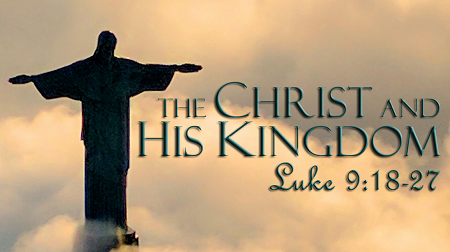
The Christ and His Kingdom (Luke 9:18-27)

The Christ and His Kingdom

Luke 9:18-27

I. Who is Jesus? (Luke 9:18-20)

    A. John the Baptist declared Jesus’ divinity (John 1:29-30)
    B. His enemies spread lies
    C. His admirers stopped believing He was the Messiah, but still held Him in high regard (Luke 9:7-8, 18-19)
    D. His apostles declared “The Christ of God” (Luke 9:20)

II. Predicting His death and resurrection (Luke 9:21-22)

    A. A warning to tell no one (Luke 9:21)
    B. The apostles’ reaction (Matthew 16:22-23; Isaiah 55:8-9)

III. Submission to God’s will (Luke 9:23-26)

    A. Desire, denial, and daily walking required (Luke 9:23-24)
    B. Nothing in this world is worth losing one’s soul (Luke 9:25-26)

IV. The kingdom (Luke 9:27)

    A. The kingdom is not still-future-to-us (Acts 2)
    B. Premillennialism is a false doctrine

Jesus Is All The World To Me

Jesus Is All The World To Me

I. The importance of Jesus to the Christian

    A. “My life, my joy, my all” (Luke 9:23; Matthew 5:10-12; Mark 12:29-30)
    B. “He is my strength…” (2 Corinthians 12:7-10)
    C. “When I am sad to Him I go” (2 Corinthians 7:4; Philippians 4:4)

II. The continual friendship and blessing of being in Christ

    A. “My Friend in trials sore” (Romans 8:35-39)
    B. “I go to Him for blessings” (3 John 2; James 4:3; Ephesians 1:3; Luke 9:25; Acts 14:17)

III. Jesus is our guide and protector

    A. “He’s so true to me” (2 Thessalonians 3:3; John 14:15; 1 Peter 5:8)
    B. “Following Him I know I’m right” (Matthew 7:13-14)

IV. Christ is our trustworthy Friend

    A. “I trust Him now, I’ll trust Him when life’s fleeting days shall end” (Ephesians 1:11-12; Hebrews 6:13-18)
    B. “Eternal life, eternal joy” (Matthew 10:29; 2 Timothy 2:11-13)

Read the New Testament in a year, one chapter a day, five days a week

Day 130/260: Read Matthew 5

Do you want to be happy? Who doesn’t? Jesus gives the keys to eternal happiness in the Sermon on the Mount. He begins with what we commonly call “the beatitudes.” The word “blessed” carries with it the connotation of happiness.

So, do you want to be happy? Jesus says be humble (or “poor in spirit”). Mourn over sin. Be meek. Crave spiritual knowledge. Show mercy. Develop purity in your heart. Make peace with those around you. Stand for what is right, regardless of the consequences in this life.

How we respond to God and how we treat other people has a profound impact on our happiness. When we focus on our own desires all the time, negativity will creep in. We see what we have not accomplished, what we do not possess, and we develop a defeatist attitude.

But when we focus on serving God and others, we obtain so much joy. By making God and other people happy, we make ourselves happy.

While I am a firm believer in the necessity to know how to say “no” on occasion, that should not be our default answer to every request. Read carefully Jesus’ words in verses 38 through 48. We must be willing to make some sacrifices to help others, to go the second mile, to give up our coat along with our tunic.

Do you want to be happy? “Love your enemies, bless those who curse you, do good to those who hate, and pray for those who spitefully use you and persecute you.”

Memory (Recite to a friend without looking)

Matthew 5:9. “Blessed are the peacemakers, for they shall be called sons of God.”

Pray

Pray for your enemies by name.

Read the New Testament in a year, one chapter a day, five days a week

Day 129/260: Read Matthew 4

The best defense against temptation is a proper knowledge and application of the inspired Scriptures, as demonstrated by Jesus when He was in the wilderness to be tempted by Satan. Three times Satan attempted to entice Jesus to sin, and three times Jesus resisted by recalling the Word of God.

We can do the same today, but only if we have a working knowledge of God’s revelation. The Psalmist declared, “Your word I have hidden in my heart, that I might not sin against You” (Psalm 119:11). Have you hidden the Word in your heart?

Here are some specific sins that many face to some extent, and passages that may help defend our soul against Satan’s assaults:

  • Foul language and dirty jokes (Ephesians 4:29)
  • Greed and materialism (1 Timothy 6:6-10)
  • Pride and selfishness (Philippians 2:3)
  • Poor attitude toward employers (Colossians 3:23-24)
  • Racism and sexism (Galatians 3:28)
  • Disobeying God (John 14:15)
  • Disobeying the elders in the church (Hebrews 13:17)
  • Envy (Proverbs 23:17)
  • Apathy (1 Corinthians 15:58)

Can we do better? We must! But we need God’s help, and that help is available in the inspired Scriptures.

Memory (Fill in the blanks)

Matthew 5:9. “Blessed are the ________________, for they shall be called sons of ________________.”

Pray

Pray for wisdom in recognizing temptation, and strength in overcoming it through God’s Word.

Read the New Testament in a year, one chapter a day, five days a week

Day 128/260: Read Matthew 3

John the Baptist played a vital role in preparing the world for Jesus Christ. There would be a dramatic change from the way things had always been before, and John encouraged the people, “Repent, for the kingdom of heaven is at hand!”

Still today, Jesus needs folks who will prepare the people around them for Him. It may be a family member, or a close friend, a neighbor, or a co-worker. They still need to hear the message of repentance. Not because the kingdom is “at hand,” or nearby, but because the kingdom has arrived! Those who die without repenting and putting on Christ in baptism, without placing their citizenship in heaven (Philippian 3:20), cannot be admitted there.

Before we teach anyone, we must “bear fruits worthy of repentance” ourselves. One who teaches others about Christ must live a Christ-like life themselves. You have little chance to convert someone to a way of life that you are not willing to live yourself. If you have sin in your life, repent! “Flee also youthful lusts; but pursue righteousness, faith, love, peace with those who call on the Lord out of a pure heart” (2 Timothy 2:22).

Make a list of people who need Jesus in their lives. Put your own name at the top of the list. Look for ways to infuse Christian character in everything you do, and encourage those around you to do the same.

Memory (Fill in the blanks)

Matthew 5:9. “________________ are the peacemakers, for they shall be called ________________ of God.”

Pray

Pray for opportunities to prepare someone else for Jesus.

Read the New Testament in a year, one chapter a day, five days a week

Day 127/260: Read Matthew 2

Herod was “troubled” because he knew he was in trouble. The wise men from the East came looking for “He who has been born King of the Jews.” Herod knew his time was coming to an end.

Isn’t that the way it is with all of us, though? When we hear about Jesus and what He demands of His followers, our time is coming to an end. Our time becomes His time; our will becomes His will. If not, we cannot truly call ourselves His disciples.

There are many songs that speak to our complete devotion to the Lord, songs such as “Have Thine Own Way” and “None of Self and All of Thee.” In 1896, Judson W. Van De Venter penned “All to Jesus I Surrender.”

All to Jesus I surrender,
All to Him I freely give;
I will ever love and trust Him,
In His presence daily live.

Are we willing to surrender all, or are we troubled at the mere mention of the One who should replace ourselves as the King of our life?

Memory (Copy into a notebook 5-10 times)

Matthew 5:9. “Blessed are the peacemakers, for they shall be called sons of God.”

Pray

Pray for a stronger commitment to the Lord; pray for strength in surrendering all to the Savior.

Read the New Testament in a year, one chapter a day, five days a week

Day 126/260: Read Matthew 1

Taking note of the intended audience of a particular passage of Scripture helps in our understanding of it. Each gospel account had a different aim and a different audience in mind. Matthew the tax collector wrote his account with his Jewish brethren in mind.

This is one of the reasons that he begins his genealogy in chapter one with Abraham. Abraham was a central figure in the Jewish faith, the “father of many nations.” The Jews took great pride in their heritage.

Matthew also refers extensively to the prophets who were esteemed by the Jewish leaders. Isaiah prophesied of the virgin birth: “Therefore the Lord Himself will give you a sign: Behold, the virgin shall conceive and bear a Son, and shall call His name Immanuel” (Isaiah 7:14).

Matthew recalls this prophecy as he tells of the angel’s visit to Joseph, who says, “Joseph, son of David, do not be afraid to take to you Mary your wife, for that which is conceived in her is of the Holy Spirit.”

Focus on the meaning of the two names given for the Lord in this chapter: Jesus, meaning “Jehovah is salvation,” and Immanuel, meaning “God with us.” What a blessing to know that Jesus has the ability and the desire to save us, and it was love that brought Him into this wicked world for that purpose.

Memory (Read aloud 5-10 times)

Matthew 5:9. “Blessed are the peacemakers, for they shall be called sons of God.”

Pray

Pray a prayer of thanksgiving for Christ’s love and mercy.

Rejection or Reception? (Luke 8:26-56)

Rejection or Reception

Luke 8:26-56

I. The rejection of the country of the Gadarenes (Luke 8:26-37)

    A. Despite a mighty miracle, the people asked Jesus to depart (Luke 8:37)
    B. Jesus left a witness behind (Luke 8:38-39)

II. The reception of the people in Capernaum (Luke 8:40)

    A. The healing of the unclean woman (Luke 8:41-48)
    B. The raising of Jairus’s daughter (Luke 8:49-56)

III. Application

    A. Do we fear change? (Luke 8:37)
    B. What do we value? (Mark 5:16-17)
    C. Do we live our lives day-by-day “waiting for Him”? (Luke 8:40)

The Faith of Abraham

The Faith of Abraham

Genesis 17:1-8

I. Abraham’s faith was based on revelation

    A. God appeared to Abraham and spoke to him (Genesis 12:1-4,6-7; 15; 17; 18; 22; etc.)
    B. Our faith must be based on God’s revelation (2 Timothy 3:16-17; Romans 10:17; John 20:30-31)

II. Abraham’s faith resulted in obedience

    A. He knew there was something greater waiting for him (Hebrews 11:8-10: Acts 7:4-5; Matthew 8:11)
    B. Abraham would not withhold anything from the Almighty (Hebrews 11:17-19)
    C. Our faith is known through obedience (Romans 1:8; 16:19; James 2:20-24)
    D. Our faith should be sacrificial (2 Corinthians 9:6-7; 8:1-5,10-12)

III. Abraham’s faith continued to grow throughout his life

    A. Abraham was not perfect (Romans 3:23; Genesis 12:10-13; 20:1-2; 15:1-3; 17:15-19) but he grew (Hebrews 11:17-19)
    B. We must also grow… like the apostles (Matthew 8:26; Acts 4:13) and like the early church (2 Thessalonians 1:3)

But when they believed Philip as he preached the things concerning the kingdom of God and the name of Jesus Christ, both men and women were baptized. (Acts 8:12)