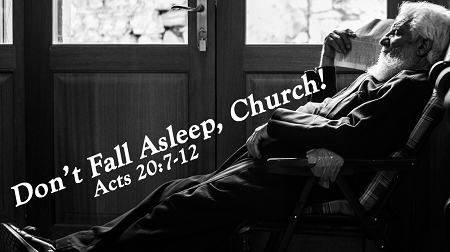
Don’t Fall Asleep, Church! (Acts 20:7-12)

Don't Fall Asleep Church Acts 20:7-12 Eutychus

Acts 20:7-12

I. Lessons for the hearers

    A. Everyone participates (even if not leading)
    B. Reasons (and excuses) for sleepiness

II. Lessons for preachers (and teachers)

    A. Are long sermons appropriate? (Acts 20:7)
    B. The important task of preachers and teachers (2 Timothy 4:2)

III. Lessons about the worship environment (Acts 20:8)
 
IV. Eutychus was pronounced dead, but came back to life (Acts 20:9-12)

    A. The joy of the people when he was revived
    B. There should be even more joy when one who was spiritually dead is made alive once again in the Lord (1 Corinthians 11:30; Romans 13:11-14; Ephesians 5:8-14)

On the First Day of the Week (Acts 20:7)

On the First Day of the Week Acts 20:7 The Lord's Supper

Acts 20:7

I. How do we know this was the Lord’s Supper?

    A. Context matters (Acts 20:7, 11; 2:42, 46)
    B. The purpose: to remember the Lord’s death, not to satisfy physical hunger (1 Corinthians 11:20-29)

II. The day and frequency

    A. Why Sunday? (Mark 16:9; 1 Corinthians 15:1-20; John 20:19)
    B. Why not the Sabbath? (Exodus 16:23-30; 20:8; 31:17; Colossians 2:17)
    C. Why every Sunday? (Acts 20:7)

Monday through Friday with People of Faith: Day 180/260: Daniel

Read Daniel 2

The Kingdom That Shall Stand Forever

The power of the Babylonians was unmatched in their day. The king, Nebuchadnezzar, had a dream that troubled him, and no man seemed to be able to interpret the dream for him. Angry with their incompetence, Nebuchadnezzar put to death many of the wise men, and sought to execute Daniel and his companions as well. Daniel, however, stepped up and told the king the meaning of his dream.

Nebuchadnezzar dreamed of a great image with a head of fine gold, a chest and arms of silver, belly and thighs of bronze, legs of iron and feet of iron mixed with clay. The image was then destroyed by a stone, and that stone because a great mountain.

Daniel explained to the king that the head of gold is Babylon; the power that Nebuchadnezzar enjoyed was given to him by God. Another kingdom would come after Babylon, inferior to Babylon, then another, and another.

We can now look back through history and identify these kingdoms that followed Babylon. The chest and arms of silver represented the Medo-Persian Empire, in power from 539-330 BC. The belly and thighs of bronze prefigured the Greeks, in power from 330-63 BC, initially led by Alexander the Great. The legs of iron and feet of iron mixed with clay represented the Roman Empire.

Daniel explains that during the days of that fourth kingdom, that is the Roman Empire, another kingdom would arise. “And in the days of these kings the God of heaven will set up a kingdom which shall never be destroyed; and the kingdom shall not be left to other people; it shall break in pieces and consume all these kingdoms, and it shall stand forever” (Daniel 2:44).

We are now many years removed from the Roman Empire, but that kingdom that God set up, prophesied by Daniel, still exists. Jesus, who lived during the time of the Caesars, told His disciples that upon their confession of Him as the Son of God, He would build His church, “and the gates of Hades shall not prevail against it” (Matthew 16:13ff). In that same passage, Jesus equated the church to the kingdom.

Are you in God’s kingdom, the church? It is the only kingdom that will stand forever.

Monday through Friday with People of Faith: Day 179/260: Daniel

Read Daniel 1

What Do You Purpose In Your Heart?

The Babylonian captivity was predicted by Jeremiah, and Daniel was one of the young men who was carried away at the beginning of the captivity. He was among the youths “in whom there was no blemish, but good-looking, gifted in all wisdom, possessing knowledge and quick to understand, who had ability to serve in the king’s palace, and whom they might teach the language and literature of the Chaldeans” (Daniel 1:4).

There was something different about Daniel, though. The Scriptures state that this young man “purposed in his heart that he would not defile himself with the portion of the king’s delicacies, nor with the wine which he drank” (Daniel 1:8). He requested an exemption from the customary diet of the eunuchs.

The chief of the eunuchs was leery about the request, as it could endanger his own life if the young men who ate differently became unhealthy because of their diet. Daniel issued a ten-day challenge and told the chief of the eunuchs that if their appearance was worse than the others, “as you see fit, so deal with your servants” (Daniel 1:13).

Daniel was not just trying to be difficult. He was well-liked by the man in charge, as the Scriptures say, “Now God had brought Daniel into the favor and goodwill of the chief of the eunuchs” (Daniel 1:9). The young man likely did as he was told without complaint, and thus the chief of the eunuchs was more willing to listen to his request.

As children of God, should we not try to get along with those around us, and with those over us? If we behave in a reasonable manner as employees, would our employers not deal more reasonably with us? If a situation arises at work that might cause us to compromise our Christian walk, and we have behaved properly in the past, our employers are more likely to listen to our concerns than if we were always difficult and always complaining.

Daniel was well-liked because his heart was in the right place. He “purposed in his heart that he would not defile himself.” Do we do the same? Are we so committed to the Lord that we make a conscious decision that no matter what, we will not stray from His command?

Consider your goals, your dreams, and your desires. What do you purpose in your heart?

Monday through Friday with People of Faith: Day 178/260: Obadiah

Read Obadiah

Stand By Or Stand Up?

Many have heard the saying, “The only thing necessary for the triumph of evil is for good men to do nothing,” which is often misattributed to an Irish statesman and philosopher. While we may not know the origin of the quote, the idea is quite correct. If you don’t stand up and say something about injustice, who will? In fact, does your silence not make you complicit in the wickedness?

In Obadiah’s prophecy, God condemns Edom for standing by and doing nothing to help Jacob when trouble came. “For violence against your brother Jacob, shame shall cover you, and you shall be cut off forever. In the day that you stood on the other side—in the day that strangers carried captive his forces, when foreigners entered his gates and cast lots for Jerusalem—even you were as one of them” (Obadiah 10-11).

Refusing to act on the behalf of those in need is the same as actively oppressing them. If you have the means and opportunity, you should do what you can to assist a person in need. The apostle Paul wrote, “Therefore, as we have opportunity, let us do good to all, especially to those who are of the household of faith” (Galatians 6:10).

Not only did Edom stand by and watch, but they were also happy at what they witnessed. “But you should not have gazed on the day of your brother in the day of his captivity; nor should you have rejoiced over the children of Judah in the day of their destruction; nor should you have spoken proudly in the day of distress” (Obadiah 12).

Why would someone find joy in another person’s suffering? Think about the bullies in school. Why were they bullies? Most of the time, they were trying to feel better about themselves, and they thought the only way to do that was to tear someone else down. God shows us the real way to happiness: through helping others. Again it is the apostle Paul, who applied a principle taught by the Lord to the action of helping the less fortunate. “I have shown you in every way, by laboring like this, that you must support the weak. And remember the words of the Lord Jesus, that He said, ‘It is ore blessed to give than to receive’” (Acts 20:35).

Don’t stand by while others are oppressed. Stand up and help.

Monday through Friday with People of Faith: Day 177/260: Habakkuk

Read Habakkuk 2

“The Just Shall Live By Faith”

God said through the prophet Habakkuk, “Behold the proud, his soul is not upright in him; but the just shall live by faith” (Habakkuk 2:4). In this truth, God presents a contrast between the one who proudly chooses his own path without regard to divine guidance and the humble one who submits to the will of the Almighty.

Three times in the New Testament the last part of that verse is quoted: “The just shall live by faith” (Romans 1:17; Galatians 3:11; Hebrews 10:38). What exactly does this mean? Does it mean as long as you believe, you can live however you wish? Certainly not, but that seems to be the way a lot of folks interpret it! When you look carefully, this statement answers three questions: who, what, and how?

Who? “The just.” What does it mean to be just? The original Hebrew word is most often translated “righteous.” Thus, “the just” is one who is righteous, who conforms his life and mind to what God has revealed.

What shall “the just” do? He “shall live.” Living is more than just breathing. Living encompasses everything you do every day. It includes going to work or school, family time, recreation, and worship. Any activity in which you are involved, that is a part of living.

“The just shall live…” How? “By faith.” If a person is righteous, it is because they have learned God’s Word and strive to obey it. It is more than simply believing in God. Rather, the decisions you make every day are influenced by that belief! You make just or righteous decisions because of faith.

The next time you are faced with a moral decision, remember the words of Habakkuk: “The just shall live by faith.” Allow your decision to be influenced by the faith that was once for all delivered and live soberly, righteously, and godly in this present age. Don’t go along with the crowd; don’t be like the proud man whose soul is not upright. Do what God commands because your faith demands such.

Monday through Friday with People of Faith: Day 176/260: Habakkuk

Read Habakkuk 1

“Why, God?”

Murder. Abortion. Gun violence. Child abuse. Have you ever looked at the evil all around you and wondered why God allows such to take place? Why does He not take action to save those who are persecuted and prevent the wicked from prospering? The prophet Habakkuk asked these questions during his lifetime.

Habakkuk was not blinded to the sin of his own people. He recognized that there was in Judah “iniquity,” “trouble,” “plundering,” “violence,” “strife,” and “contention” (Habakkuk 1:3). He was not the first of the prophets to decry the iniquity of the people of God. Read Hosea 4:2 and Micah 6:12-13 for other examples of such. Habakkuk questions the Lord about all the sin that is going unchecked, and then God answers.

“Look among the nations and watch—be utterly astounded! For I will work a work in your days which you would not believe, though it were told you. For indeed I am raising up the Chaldeans, a bitter and hasty nation which marches through the breadth of the earth, to possess dwelling places that are not theirs” (Habakkuk 1:5-6). God will use Babylon, a nation more wicked than Judah, to punish His people.

This creates a similar question in the prophet’s mind: “Why do You look on those who deal treacherously, and hold Your tongue when the wicked devours a person more righteous than he?” (Habakkuk 1:13).

It was not that Babylon was more righteous—they weren’t. Rather, it was that Judah had fallen so far from God’s Word that they needed to be set right. A remnant needed to be preserved for God’s eternal purpose to be fulfilled in the church.

When we struggle in life, even at the hand of an enemy, let us take a step back and reexamine ourselves and our spiritual situation. Be sure that we are doing all we can to live faithfully and set a proper example for others. Further, let us be certain to respond to such struggles in a Christ-like manner, looking for opportunities to use those difficulties to spread the gospel and shine the light of Christ in our lives.

God is Longsuffering

God is Longsuffering

I. God was longsuffering in the Old Testament

    A. Adam and Eve (Genesis 2:15-16; 3:16-19, 22-24; 3:15)
    B. Abraham (2 Chronicles 20:7: James 2:23; Genesis 12:10-20; 20:1-2)
    C. Moses (Exodus 3:7-10; 4:14)

II. God was longsuffering in the New Testament

    A. Thomas (John 11:8, 16; 14:1-6; 20:24-29)
    B. Paul (1 Timothy 1:13; Acts 8:1, 3)
    C. John Mark (Acts 13:5, 13; 15:38; 2 Timothy 4:11b)

III. God is longsuffering with us today

    A. The fact that Jesus has not yet returned is evidence of God’s longsuffering with us (2 Peter 3:1-9)
    B. We have work to do (Matthew 28:19-20)

Monday through Friday with People of Faith: Day 175/260: Jeremiah

Read Jeremiah 17

Who Do You Trust?

The Scriptures issue grave warnings against trusting untrustworthy things. The apostle Paul tells Timothy, “Command those who are rich in this present age not to be haughty, nor to trust in uncertain riches but in the living God, who gives us richly all things to enjoy” (1 Timothy 6:17).

What makes earthly riches “uncertain”? Jesus answers in the Sermon on the Mount: “Do not lay up for yourselves treasures on earth, where moth and rust destroy and where thieves break in and steal” (Matthew 6:19). Earthly treasures are temporary. They can be destroyed or stolen. Heavenly treasures, though, cannot be taken away from a faithful person.

Jeremiah warns not against trusting in temporary treasures, but against anything that is not rooted in God Himself. “Cursed is the man who trusts in man and makes flesh his strength, whose heart departs from the Lord” (Jeremiah 17:5). When a person begins to trust in his own abilities and fails to recognize from whom those abilities come, he is sure to stumble!

The prophet presents a contrast between trusting man and trusting God. He who feels secure in the flesh is “cursed” (17:5), while the man who trusts in God and puts his hope in God is “blessed” (17:7).

The man who relies on his own strength is “like a shrub in the desert…the parched places in the wilderness, in a salt land which is not inhabited” (17:6). There is no prospect for improvement in that man. But the man who is confident in the Lord “shall be like a tree planted by the waters, which spreads out its roots by the river…its leaf will be green, and will not be anxious in the year of drought, nor will cease from yielding fruit” (17:8). Nothing can stop the growth of the man whose source of life and energy is the Almighty!

Notice also that the man who trusts in the flesh “shall not see when good comes” (17:6). The one who has a lot of money just wants more money. There is never any peace or contentment with what he already possesses; he simply looks for more. By contrast, the one who trusts in God “will not fear when heat comes” (17:8). There is a calmness of the heart in knowing that God is your provider and protector.

Who do you trust?

But when they believed Philip as he preached the things concerning the kingdom of God and the name of Jesus Christ, both men and women were baptized. (Acts 8:12)